
The 2026 Met Gala had everything it needed to be extraordinary. An exhibition that placed the dressed body at the centre of art history, and a dress code — “Fashion is Art” — that invited interpretation as broad and ambitious as the guests cared to be. What followed, for the most part, was incredibly bland and boring.
This year’s spring exhibition, “Costume Art,” curated by Andrew Bolton, focuses on the role of the dressed body, placing paintings, sculptures, and objects in dialogue with historical and contemporary garments from the Met’s Costume Institute. It is organised around three categories of bodies:
- the classical and nude (omnipresent in art, always inscribed with cultural values)
- the ageing and pregnant (conspicuously overlooked)
- and the anatomical (universal).
Fashion and the dressed body, Bolton has said, connect every curatorial department and every gallery; it is the common thread throughout.
The opening of the exhibition was celebrated with the Met Gala on Monday. The accompanying dress code “Fashion is Art” encouraged guests to treat their body as a canvas. A canvas that, sadly, the vast majority of guests left blank, resulting in perhaps the most colourless, most creatively bankrupt Met Gala in recent memory.
Missed Opportunities: The Looks That Almost Were
Several looks arrived with genuine potential, only to abandon it halfway through. Two were particularly frustrating in this regard: Lena Mahfouf in Burc Aykol and Irina Shayk in Alexander Wang.


Mahfouf’s look started promisingly: The sculptural hands were an inspired touch, but the concept was never followed through. Shayk’s top, constructed from watches and bracelets, was a genuinely exciting proposition, but little more than a bra in practice. The problem is that the look simply stopped. What should have been a full bodice, and ideally a skirt that rippled downward like the melting clocks of Dalí’s The Persistence of Memory (1931) gave way to a plain black maxi skirt, as if someone ran out of time and reached for whatever was closest. For a dress code explicitly asking guests to treat fashion as art, abandoning a look at the most interesting moment is a particular kind of failure.

Olivia Wilde in Thom Browne offers a beautiful piece: A gown that takes the silhouette of Gilded Age undergarments, most notably the bustle, and makes them the spectacle rather than the scaffold, creating this really stunning and interesting look.

But it belongs to a different evening. This was a look I was sorely missing at the 2022 Met Gala, “Gilded Glamour” where it would have been perfectly, thrillingly in conversation with the theme. In 2026, with the dressed body as canvas, it reads as a missed connection rather than a statement.
The most egregious misstep of the evening, however, was Lauren Sánchez Bezos in Schiaparelli, described by Vogue as channelling Madame X by John Singer Sargent. If you read this blog regularly, you will know that Sargent’s Gilded Age portraits are a subject of particular interest to me, I therefore find this look particularly insulting. Sargent was a master of rendering the relationship between dress and identity: The weight of fabric, the play of texture, the way a garment could either fortify or expose the person wearing it. This look captures none of that.


The colour is wrong. The fabric reads differently. The jewelled strap — the most loaded detail in the painting, the one that caused a public scandal at the 1884 Paris Salon — looks enlarged and theatrical here, as if the reference were being underlined for an audience unfamiliar with the original. And the fit is not, in any sense, Madame X. More damningly, we have seen75 variations of this silhouette on her before; the look is less a homage than a lack-lustre repackaging. If you spend $10 million to attend the Met Gala — attend and give us something spectacular!
Contrast this with Claire Foy, who, without attempting an exact replica, produced a far more convincing and considered interpretation of Madame X. The structure of her gown carries the quality, or at least the convincing appearance of quality, that Sargent’s portrait demands. The strap is subtly embellished rather than theatrical. Most tellingly, Foy and her team engaged with Sargent’s actual technique: The fabric draped over her arms echoes one of his most recurring compositional gestures, and the veil across her face speaks directly to his remarkable ability to distinguish between opaque and sheer materials. This is what it looks like when a reference is genuinely understood rather than loosely approximated.

Lady Helen Vincent, Countess d’Abernon by John Singer Sargent, 1904 (top right).
Margaret Howard, Countess of Suffolk by John Singer Sargent, 1898 (bottom left).
Charlotte Louise Burckhardt (‘Lady with the Rose’) by John Singer Sargent, 1882 (bottom right).
The Evening’s Exceptions
Emma Chamberlain opened the carpet in Mugler and Chopard, and for a brief, optimistic moment it felt as though the evening might deliver on its promise. Her gown featured a bodice painted with actual paint, creating tactile, visible texture, before cascading into a train dipped in shifting colours, the hem achieving something close to a watercolour effect. When she stepped out first, I was genuinely excited. The disappointment that followed was proportionate to that excitement.

Sabrina Carpenter was, for me, the standout of the night. Her custom Dior and Chopard ensemble was constructed almost entirely from film, specifically, the 1954 film Sabrina, starring Audrey Hepburn. This is what the dress code was asking for. Film is itself an art form; to take it as a raw material and sculpt it into fashion is to do exactly what the exhibition’s premise demands: To collapse the distance between artistic medium and dressed body. The personal dimension is there too; the Sabrina reference anchors her recent “Sabrinawood” era at Coachella. It is the most complete and considered look of the evening. This, is art.

Heidi Klum in Mike Marino divided opinion online, and I understand why. It was, undeniably, an obvious interpretation: She arrived as a statue. But someone had to, and she committed to it entirely from head to literal toes, the illusion of marble was complete. The criticism that it skewed Halloween-costume is not entirely unfair — Klum’s relationship with elaborate transformation is well-documented — and I also thought it was a bit costume-y, but I have to admire her commitment. And, obvious doesn’t mean wrong.


Kylie Jenner’s look took me a moment, partly, I admit, due to my own prejudices when it comes to the Kardashian/Jenner clan, but once I understood the reference to the Venus de Milo, I was pleasantly surprised. The corsetry bodice, mimicking the classical nude torso, paired with a dress that appears to be slipping from the body, is a genuinely intelligent interpretation: It takes a universally legible piece of classical sculpture and gives it a contemporary tension. One adjustment would have elevated it from good to excellent: an updo in the manner of classical statuary, rather than loose curls, would have closed the conceptual loop rather than leaving it slightly ajar.

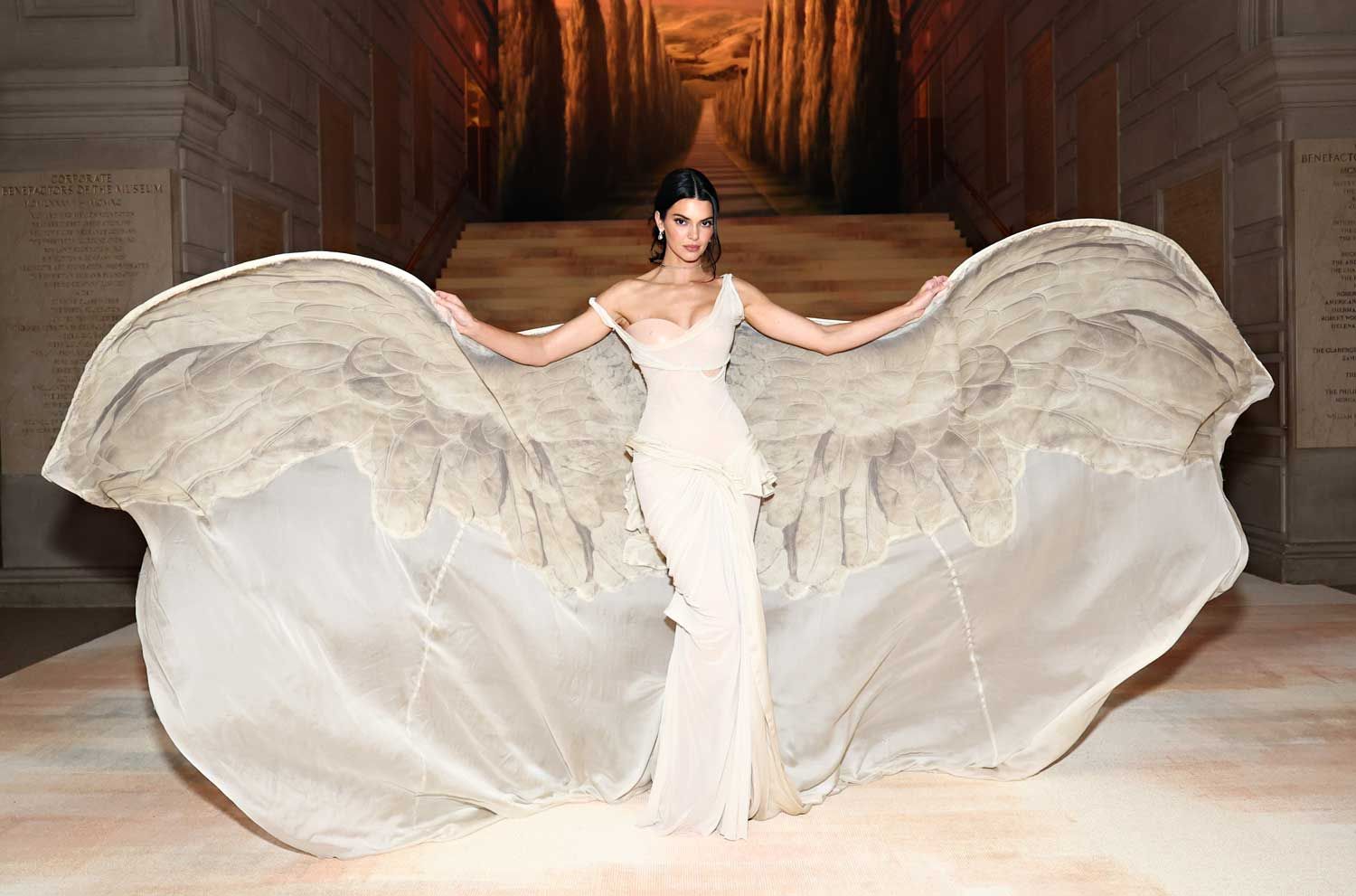
Kendall Jenner is more complicated. On the carpet, I found her look beautiful but slightly inert. The fabric was draped exquisitely, the naked-illusion corsetry echoing her sister’s, but it felt like a register short of a full idea. Then came the photographs from inside: A second train that unfurled into wings, evoking the Winged Victory of Samothrace. That transformation should have happened on the Met stairs. It is the kind of moment the Met Gala exists to create, and it was wasted on an interior corridor.

On the same Winged Victory inspiration: Yu-Chi Lyra Kuo in custom Jean Paul Gaultier deserves mention as one of the evening’s most technically accomplished looks. The origami folding which was meticulously constructed to evoke unfurled wings, referencing Nike, the Greek goddess of victory, was intricate, artful, and clearly the product of serious craft.

In Defence of the Met Gala
Before arriving at the conclusion, I want to address the criticism that the Met Gala, in any form, is indefensible.
Every first Monday in May, as ticket prices sit at over £50,000 per guest, the rest of us are grappling with extortionate rents, no realistic prospect of property ownership, and ever rising food and utility costs. The spectacle is a valid target. But the Costume Institute, the sole curatorial department of the Met Museum that receives no funding from the museum’s endowment, must finance itself entirely, and the Gala has been its primary source of annual funds since the first Met Ball in 1948. It was Diana Vreeland, and subsequently Anna Wintour, who transformed it into the cultural spectacle that keeps designer brands willing to pay those extortionate ticket prices: Because the carpet offers their work global visibility, which translates into revenue. The mechanism is cynical, but it functions, and what it funds — the preservation of centuries of dress as material culture — matters.


Dress is not a minor footnote to human history. It is evidence of how we have constructed identity, marked status, performed gender, and signalled belonging across every culture and every era. It deserves the same institutional seriousness we extend to painting, sculpture, and architecture. The Costume Institute does that work.
The counter-argument that brands with the capital to fund Met Gala tickets could instead direct that money toward humanitarian causes is well founded. But I find that argument insufficient as a critique to stop the event entirely. Amazon, Apple, and the major fashion houses have the resources to support both the Costume Institute and to make meaningful contributions to the crises facing the world. That they do not do the latter is a failure of will, not of capacity. Doing one does not preclude the other. The uncomfortable truth is that humanitarian investment yields no measurable return on capital for these corporations — and that, ultimately, is the only metric that moves them.
Met Gala 2026: The Price of Admission
The 2026 Met Gala marks a clear breaking point from everything that came before it, and I mean that in a specific, institutional sense, not merely a sartorial one.
It is not unusual for the Met Gala to be sponsored by companies with questionable ethics. What is new is who sponsored it this year: Jeff and Lauren Sánchez Bezos, not as representatives of Amazon or any brand entity, but as private individuals. The distinction matters. Corporate sponsorship, however morally complicated, operates within a logic the Gala has always understood: Exposure in exchange for capital. What the Bezoses purchased at a reported $10 million was something different. They purchased admission to a cultural institution that was supposed to be beyond purchase.
Anna Wintour has long maintained that the Met Gala guest list is non-negotiable, that no one buys their way in, that every name must be approved, and that the event’s value derives precisely from that selectivity. That principle has now been compromised, and it cannot be uncomprised. Once the door is opened at a price, the question is no longer whether others can buy entry, but at what cost. The Met Gala ceases to be a fundraiser with cultural cachet and becomes, instead, social currency available to anyone with sufficient capital and a sufficiently absent moral imagination.
And that is exactly what we saw on the carpet. The fashion, with the exceptions noted above, was as transactional as the event itself. In a stronger year, a year in which the guests had shown up with the ambition the theme deserved, most of what passed for a standout look in 2026 would have been mid. The bar was on the floor, and it was still only cleared by a handful.
When the supposed arbiter of the fashion world arrives at the Met Gala in what is effectively the same dress for the third time, is mediocre in construction and indifferent to the theme, the message sent to every stylist, every designer, and every guest is clear: Excellence is optional.


When the institution that hosts the evening has already signalled that standards are for sale, why would the carpet be any different?
Leave a Reply