
Spooktober has arrived and Halloween is just around the corner. Every year, witch costumes appear in stores, online, and on social media, from playful ensembles to dramatic, cinematic recreations. But where does the typical iconic image of the witch with the pointed hat and broomstick come from, and why does it continue to captivate our imagination?
The origins of the classic witch costume are surprisingly complex. Rooted in centuries of folklore, fear, and societal biases, historical witch stereotypes shaped the visual cues we now associate with witches and witchcraft. The pointed witch hat, the flowing or ragged garments or stays, all carry symbolic meaning, reflecting gendered perceptions of power, otherness, and domesticity.
This article traces the evolution of witch fashion from early European depictions, Halloween classics to the revived “Whimsigoth” of the 1990s.
The Origin of the Witch Costume
The witch as we recognise her today — pointed hat, flowing dark robes, corseted tops, broom in hand — is a figure shaped as much by history as by imagination. Her image draws upon centuries of fear, fascination, and storytelling. To understand how this enduring archetype emerged, we must look back to the social anxieties, fashion conventions, and visual culture that first defined what a witch looked like.
From Persecution to Pop Culture: The Salem Influence on Witch Costume History
The stereotypical image of the witch often draws from period clothing, most commonly from the 17th century, or the Middle Ages. The influence of “The Purges” — the period between roughly 1450 and 1750, when witch hunts, trials, and executions were widespread across Europe and the Americas — continues to be present in Halloween costumes today. The hysteria reached its peak between 1560 and 1630, with the last recorded execution for witchcraft in Europe taking place in Switzerland in 1782.
Unsurprisingly, this era left a lasting imprint on the origin of the witch costume. While men, too, faced accusations of witchcraft, women were disproportionately targeted, making witchcraft an inherently gendered phenomenon. As a result, everyday dress of early modern women, such as bodices, aprons, skirts, stays, and linen blouses are a staple in Halloween costumes and across film adaptations.
Although medieval and early modern garments could be vibrant and richly dyed, such colours were costly and reserved for the upper classes. Because accusations of witchcraft, trials, and ultimately executions were mostly confined to the lower classes, the witch costumes we see in literature, theatre, and film have instead focused on ordinary, working-class women. The result is a palette of muted earth tones.
Certain historical witch stereotypes persist in contemporary design. Elements like slashed sleeves, peasant-style blouses, and corset-laced bodices echo the fashions of the 17th and 18th centuries. These details, whether in Halloween costumes or stylised versions on screen, help bridge the past and present, reinforcing a lineage of imagery that had its origin centuries ago.


The dominance of the colour black
Today, the vast majority of witch costumes sold for Halloween are black or paired with other dark hues — a colour scheme that has long dominated portrayals of witches outside of strictly 17th-century period pieces. This all-black garb symbolises an association with evil, the Devil, and black magic.
But why this enduring dominance of black in witch costumes in film and costume history? The answer lies in centuries-old symbolism. In Christian theology, God represents light and goodness, while Satan embodies darkness and moral corruption. Black, as the absence of light and visual shorthand for evil itself, naturally lent itself to the costuming of characters linked to Satanism and the occult, aka, the witch.
In witch fashion in film, the choice of black also serves a practical and aesthetic purpose. Dressed in darkness, witches blend seamlessly into the nocturnal settings in which they are so often shown practising their craft. Many cinematic depictions of witchcraft unfold under the cover of night, and black clothing affords witches an added layer of concealment, an ability to move unseen, shrouded both literally and symbolically in mystery.
Cinema later cemented this association. From the Wicked Witch of the West in The Wizard of Oz to the darkly glamorous figures of American Horror Story: Coven, witch fashion in film and popular culture has long used black to embody both power and danger on screen.
Ageing and Otherness in Witch Fashion History: The “Old Hag”
Among the most persistent witch stereotypes is the “old hag”: The wrinkled, stooped, and frightening figure clad in ragged clothing. In witch fashion in film and popular culture, this depiction has endured for centuries, evolving from folklore to fairytale and beyond. Sometimes, the portrayal is grotesque, including exaggerated physical features, deformed bodies, and gnarled faces. Other times, it merely reflects the natural process of ageing, framed through a lens of suspicion and fear.
The origins of this image lie in the perceptions of older women in early modern society. Those who lived alone, widowed or unmarried, and who possessed knowledge of herbal medicine or healing were especially vulnerable to accusations of witchcraft. Their wisdom and independence made them threatening. In this sense, the “old hag” became a potent emblem of witchcraft and gendered fashion, where the appearance of a woman’s body — and particularly its ageing — was weaponised as proof of moral decay.
This association between physical “ugliness” and moral corruption became deeply embedded in Western storytelling. Fairytales such as those collected by the Brothers Grimm shaped how later generations would visualise witches: As old, “ugly” women opposing the youth and beauty of virtuous heroines. Features like long crooked noses, warts, and moles became a visual shorthand for otherness and evil; an intersection of caricature, misogyny, and, antisemitic imagery. These traits conveyed the idea that sin could be read on the body, that deformity mirrored depravity.
As Glinda the Good Witch famously declares in The Wizard of Oz, “Only bad witches are ugly.” The line captures centuries of moralised beauty politics and how appearance was (and often still is) tied to notions of goodness and femininity.

In witch fashion in literature and film, this duality often manifests through transformation. Disney’s Snow White and the Seven Dwarfs (1937) and the later horror retelling Snow White: A Tale of Terror (1997) both feature a witch who alternates between a glamorous, seductive form and the “old crone”. Her beauty fades as she commits acts of dark magic, her body decaying in tandem with her moral corruption. This transformation visualises an enduring anxiety about female power and desire in storytelling, particularly in fairytales; the belief that women who transgress social boundaries inevitably become monstrous.


The Evil Queen in Snow White and the Seven Dwarfs (1937), and Sigourney Weaver as Lady Claudia Hoffman in Snow White: Tale of Terror (1997).
Key Elements in Witch Costume History
The key features of the witch costume — the pointed hat, cloak, and broomstick — each carry layered theories of origin that blend historical influences, prejudice, and theatricality.
The Iconic Witch Hat: Historical Influences and Pop Culture Adoption
The pointed hat is perhaps the most iconic element of the witch costume, yet its historical origins are unclear. Pointed hats have existed since the Bronze Age, and over time, a number of theories have emerged to explain how they became associated with witches from medieval prejudice to 17th-century religious dress. By the 1700s, imagery of women accused of witchcraft wearing conical hats was already circulating, setting the stage for their later appearances in witch costumes in film and literature.
- Antisemitic Origins
One theory traces the witch’s pointed hat to the “Judenhut,” a conical hat that Jewish people were forced to wear in parts of medieval Europe (see figure on the right in the image below). This style marked them as outsiders, and over time, prejudiced depictions associated the hat with evil and black magic. While this isn’t proven to be the sole connection, it remains a compelling hypothesis in the study of witch costume history, highlighting how visual markers of “otherness” could evolve into enduring historical witch stereotypes.

- Anti-Quaker Prejudice
Another hypothesis links the pointed hat to the dress of 17th-century Quaker women. Unlike other Christian communities, Quaker women could exercise a notable degree of authority within their faith, even serving as ministers. In The Quaker: A Study in Costume, Amelia Mott notes that female Quakers preaching the faith wore broad-brimmed, somewhat conical hats.

While these hats were not unique to Quakers — they were part of broader female fashion of the period (see portrait below of Mrs Salesbury) — religious prejudice and accusations of witchcraft (due to the increased power women held within the Quaker faith) may have contributed to the hat gradually entering the visual canon of witch attire. Although Quaker hats were not sharply pointed, their canonical shape is strikingly reminiscent of what would later become the iconic “witch hat”.

- From Alewife to Witch
Another theory suggests that the pointed hat reflects the distinctive headgear of alewives — women who brewed beer for sale (there’s also a connection to be made to the “witch’s brew and cauldrons). These women often occupied marginal social positions and were frequently regarded with suspicion. Over time, their headwear may have been stylised and absorbed into the emerging iconography of witches, linking everyday female dress to the symbolism of witch’s attire and the gendered dimensions of witchcraft.

Draped in Darkness
Cloaks have a long history as practical garments, worn for warmth and protection. As such, they naturally became part of the early visual vocabulary of witches’ attire, especially in the era of the witch trials. Their association with ordinary dress from this period helped cement them in the origin of the witch costume.
Once cloaks fell out of everyday fashion, they continued to appear in theatre, television, and film as part of period costumes, signalling that the wearer belongs to another time. This “otherness” enhances the witch’s visual identity, reinforcing historical witch stereotypes. The cloak’s physicality also allows it to conceal the wearer, covering the head and body, which complements the portrayal of witches as secretive, mysterious, or morally ambiguous.

At the same time, cloaks can heighten dramatic effect, drawing attention to the wearer and lending a sense of theatrical flair. Disney’s early animated films frequently draped witches in cloaks, from Snow White to Sleeping Beauty, blending practical costume history with the visual demands of witch fashion in film and popular culture.

The Broomstick: Flight, Folklore, and Witch Costume History
Between the early and late Middle Ages, the perception of witches and their association with flight — eventually linked to broomsticks — underwent a significant transformation. In the 11th century, Bishop Burchard of Worms described women who, while asleep, believed they were riding animals in the dead of night, dismissing such visions as mere illusions. By the 15th century, these nocturnal flights had become associated with witches’ gatherings and devil worship and other nefarious acts. According to historian Michael D. Bailey, part of this shift stemmed from “magic manuals” that made their way to Europe from the East, and included descriptions of humans in flight, albeit of men, riding “demon horses” instead of women riding brooms.

Women were increasingly viewed as particularly susceptible to witchcraft, a perception that helped solidify historical witch stereotypes. The notion that witches might travel by broomstick — often contrasted with men riding demon horses — reinforced the idea of women as tied to the domestic sphere, even though the first recorded confession of broom flight was made by a man. Guillaume Edelin, a prior, is credited with the first oral account of witches flying on broomsticks; he confessed to witchcraft under torture, detailing that he flew on a broom to meet the devil. Other sources suggest a pagan harvest ritual of a dance with brooms between their legs to encourage crop growth, illustrating that multiple cultural practices contributed to the broomstick’s symbolism.
The broomstick’s transformation from household tool to magical vehicle is reflected in early visual culture as well. The earliest known illustration appears in a mid-15th-century manuscript of Martin le Franc’s Le Champion des Dames, depicting two witches in medieval dress flying on broomsticks. The Museum of Witchcraft and Magic notes that the Valais witch trials (1428–1447) likely inspired this imagery.

While the precise origin of this iconic accessory is difficult to pinpoint, these multiple threads — folklore, trial records, ritual practices, and early illustrations — collectively shaped the stereotypical image that endures in witch fashion in popular culture.
The Witch on Screen: Two Defining Portrayals
Witches have long been a fixture of cinema, their image continually reshaped. Out of the many witch films that have populated our screens — from The Love Witch, Robert Eggers’ The Witch, The Craft to Practical Magic and many more — I’ve picked two stand out examples to take a closer look at: The Wizard of Oz (1939) and Hocus Pocus (1993). Both movies defined how modern audiences imagine witches, drawing on centuries of historical stereotypes.
The Wizard of Oz, with its striking technicolor palette, introduced one of the most iconic witches in film history, while Hocus Pocus reimagined the witch for a playful, family-friendly audience without losing the allure of danger and mystery. Together, they illustrate the evolution of witch fashion in film and popular culture from the fearsome and grotesque to the camp and charismatic. With the Wicked film adaptations breathing new life into Oz’s most infamous witch, and Hocus Pocus becoming an essential autumn re-watch, it seemed only fitting to take a bit of a closer look at these portrayals.
The Wicked Witch of the West
Perhaps the most recognisable witch in modern cinema, the Wicked Witch of the West stands as a cornerstone of witch fashion in film. Her black gown, pointed hat, and green skin have become instantly recognisable. The decision to give her green skin was partly driven by technology: The filmmakers wanted to take advantage of the novelty of technicolor and contrast Oz’s fantastical world with Kansas’s real world in black and white.
Yet this green hue carries deeper symbolic weight. In folklore, the colour green has obviously long been linked to nature, evil masked in green makes it much easier for said evil to hide in plain sight. Green is also linked to sickness, which, before modern medicine, was often attributed to evil spirits or demonic possession.


Margaret Hamilton as The Wicked Witch of the West in The Wizard of Oz (1939).
Her costume, designed by Adrian Greenberg, draws from both period fashion during the witch hunts and late Victorian influences. The slashed puffed sleeves recall Renaissance dress, an aesthetic often reused in fairytale cinema. Beneath her cloak, a high-necked bodice and layered skirt evoke the silhouette of the late-19th century, while the corseted waist and structured bodice is inspired by 17th-century stays, reminiscent of the witch’s Salem predecessors.


The Wicked Witch’s look has since become a staple, resurfacing in countless adaptations and reimaginings, such as the latest Wicked with Cynthia Erivo as Elphaba (The Wicked Witch of the West) in 2024.

The Sanderson Sisters
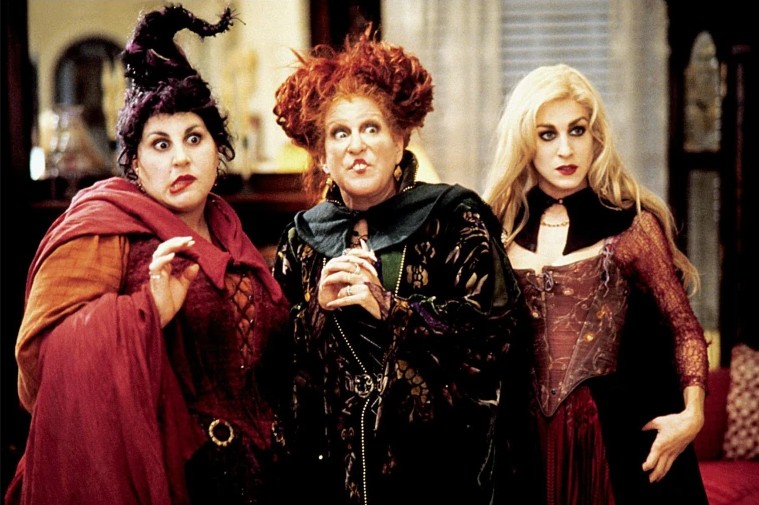
The three Sanderson sisters — Winifred, Sarah, and Mary — represent a more playful take on witch fashion in popular culture, combining historical inspiration with Disney’s signature theatrical flair. Their story begins in 17th-century Salem, and their costumes loosely echo that period’s attire with bodices, skirts, and cloaks that nod to early modern styles. But this being Disney, realism gives way to fantasy. However, their designs also borrow elements from medieval rather than strictly 17th-century dress, giving the trio a fairytale-esque quality.

Rather than the sombre blacks or earthy tones of traditional witch costumes in film, the Sanderson sisters’ garments burst with layered jewel tones, including deep purples, greens, reds, and oranges, reflecting their mischievous and loud personalities. The result is a distinctive blend of historical witch stereotypes and fantasy storytelling, made memorable through each witch’s unique palette and silhouette.

Over three decades after its release, Hocus Pocus has achieved cult status, its costumes inspiring countless Halloween recreations and cementing the Sanderson sisters as some of the most recognisable witches in cinematic history.
The Witch Rebranded
The image of the witch as we know it today — pointy hat (usually black), corseted dress, and broomstick in hand — was largely solidified during the early twentieth century, when dressing up for Halloween became a widespread custom. From the 1920s onwards, the witch costume transitioned from something folkloric to a cultural archetype, drawing on centuries of witch costume history and historical witch stereotypes.

Soon enough, this image was also filtered through the lens of gendered expectations and pop culture aesthetics. As with most female Halloween costumes, the witch’s look soon acquired its “sexy” variant. Short skirts, corseted bodices, plunging necklines, and fishnet tights have become visual shorthand for a different kind of transgression: not demonic, but sensual.

Yet the origins of the witch costume we see pop up on Halloween each year do carry an ironic echo of this connection between witchcraft and perceived immodesty. In medieval and Renaissance art, witches were often depicted nude or semi-nude, their hair loose and wild. This visual rebellion — uncovered hair and bare skin — stood in direct opposition to the expectations of modesty in their time, when married or mature women wore their hair bound and covered, and their bodies concealed under multiple layers of fabric. To appear with hair unbound was to signal moral looseness and rebellion against patriarchal order. Nudity in early witch iconography also linked to associations with pagan rituals, many of which were rumoured to involve ritualistic nakedness. These depictions projected anxieties about female autonomy, the body, and the supernatural.

Approximately from the 1930s onwards, the witch had begun to shift in tone and narrative. No longer confined to the realm of evil, she could also be a figure of power or benevolence — the “good” or “white” witch. This diversification of character was mirrored in witch fashion in film and literature. One of the earliest examples is perhaps Glinda the Good Witch in The Wizard of Oz, whose pink tulle gown and sparkling crown offered a striking counterpoint to the black-clad Wicked Witch of the West. Through such portrayals, witch fashion in popular culture expanded beyond darkness to include glamour, fantasy, and hyper-femininity.


The ‘Whimsigoth’ Witch
In the 1960s, television shows like Bewitched and later Sabrina the Teenage Witch in the 1990s introduced the concept of the “domestic witch” — a woman who looked perfectly ordinary, dressed in contemporary clothing, yet possessed magical power. These portrayals subtly destigmatised the witch, reimagining her not as a threat to society, but as a witty, fashionable woman navigating everyday life.


Elizabeth Montgomery as Samantha in Bewitched (1964-1972) and Melissa Joan Hart as Sabrina in Sabrina The Teenage Witch (1996-2003).
The 1990s then gave rise to what is now known as ‘Whimsigoth’: A fusion of whimsy and gothic sensibility that drew inspiration from 1970s bohemianism and mystical aesthetics. This look, recently revived on social media, is characterised by celestial motifs, flowing skirts, velvet, flared sleeves, and a moody palette of deep purples, blues, and forest greens. It merged the romantic and the occult, reflecting a generation intrigued by self-expression and spirituality.
Witch fashion in film of the 1990s further popularised this aesthetic. Practical Magic (1998), The Craft (1996), Buffy the Vampire Slayer, Charmed, and Sabrina the Teenage Witch all contributed to the portrayal of witches as stylish, empowered young women. Witchcraft became a metaphor for individuality and power, rather than evil. The styles on screen then inspired the look for “off-screen wannabe witches.”


Nicole Kidman as Gillian Owens in Practical Magic (1998) and Melissa Joan Hart as Sabrina in Sabrina The Teenage Witch (1996-2003).
As with many 1990s-inspired fashion trends, the ‘Whimsigoth’ witch has made a striking comeback in recent years. To be called a “witch” is now a compliment, a celebration of independence and mystique rather than a mark of suspicion. This revival owes much to the early 2010s resurgence of the “cool teenage witch,” embodied most vividly by American Horror Story: Coven (2013). Set in present-day New Orleans, the series showcased a wardrobe that married witch fashion in film with street style of the early 2010s — black fedoras and bowler hats replacing the pointed hat, sleek maxi dresses standing in for capes, and long flowing sleeves echoing the drama of earlier centuries.

As with many 1990s-inspired fashion trends, the ‘Whimsigoth’ witch has made a striking comeback in recent years. To be called a “witch” is now a compliment, a celebration of independence and mystique rather than a mark of suspicion. This revival owes much to the early 2010s resurgence of the “cool teenage witch,” embodied most vividly by American Horror Story: Coven (2013). Set in present-day New Orleans, the series showcased a wardrobe that married witch fashion in film with street style of the early 2010s — black fedoras and bowler hats replacing the pointed hat, sleek maxi dresses standing in for capes, and long flowing sleeves echoing the drama of earlier centuries.

Coven also featured Stevie Nicks as herself. Throughout her career, Stevie has embraced the “witchy” aesthetic of flowing chiffon, lace shawls, and layers of black, her lyrics often drawing from mysticism and folklore. Once wary of the witch label, she later embraced it, even nicknaming an album The White Witch and appearing on American Horror Story as a self-referential embodiment of the aesthetic she helped define. Her influence bridges generations from the bohemian witches of the 1970s to the digital “witchcore” revival of today.


From Condemnation to Celebration
From the manuscripts of early modern Europe to the glossy screens of Hollywood, the witch’s wardrobe has come a long way. What began as a visual manifestation of fear — of ageing, of female autonomy, of knowledge and sensuality — has transformed into an emblem of empowerment and individuality. The pointed hat and black cloak that once marked the outsider have become tools of self-expression, endlessly reinterpreted through fashion, film, and fantasy.


Select Sources
- “How the medieval witch image has evolved over centuries” by Jennifer Farrell (The Independent, 2018)
- “The Fashion of Horror: Witches” by Girl On Film (YouTube, 2024)
- “A Witch Fashion History” by Hali’s Room (YouTube, 2022)
- “The Quaker: A Study in Costume” by Amelia Mott Gummere (Internet Archive, 1901).
- “The Witches Hat” by The Museum of Witchcraft UK (2021).
Leave a Reply