
The Italian woman must follow Italian fashion. Taste, elegance and originality have demonstrated that this initiative can and must be successful.
— Italian Fascist Party, 1933
Power, Propaganda, and the Politics of Dress
The connections between fashion and fascism have always existed. From Mussolini’s Italy and Nazi Germany to dystopian fashion in TV shows, like The Handmaid’s Tale, authoritarian regimes have long understood the symbolic and practical power of clothing. Again, fashion is far from just a frivolous side thought. Fashion becomes a battleground for ideology, control, and identity.
In the 1930s and 40s, the Italian fascist regime systematically employed the fashion industry to sculpt a new vision of femininity in service of the state. Women were (re)shaped through state-issued fashion ideals and controlled aesthetics that reinforced traditional roles. Fast forward to the fictional theocracy of Gilead, and we see this same strategy elevated to new, dystopian heights: colour-coded clothing, mandatory uniforms, and the erasure of individuality all serve as tools of oppression.
This article explores the costume design in The Handmaid’s Tale, focusing on how it reflects themes of power, gender, and control.
The Fashion of Oppression: La Nuova Italiana
Following the post-WWI fashion moment of la maschietta — Italy’s version of the flapper or tomboy — fascists began to push back on this modern, liberated woman. Shorter hemlines, trousers, and masculine tailoring were seen as dangerous emblems of postwar female freedom. And so, fashion was conscripted into the fascist cause.
The state took control of textile production, fashion magazines, and the very image of the Italian woman. The nuova italiana — the new Italian woman — was glamorous, modest, and hyper-feminine. Hemlines dropped again, sleeves became more voluminous, and silhouettes became soft and maternal.


Two key state campaigns:
- La Nuova Italiana
Promoting elegance and femininity in the cities, the ideal woman was polished, modest, and patriotic in her Italian-made garments.
- Massaie Rurali:
For rural women, the image was even more constrained. Wearing traditional peasant clothes, which included a long skirt, voluminous blouse, and a corset, they were cast as “ladies of the field,” valued for their fertility and domesticity.

A key aspect, especially with the massaia rurale is the erosure of individuality that makes clothing a means of power and control, something that is very obviously picked up in The Handmaid’s Tale.
Fashioning Fascism in the Republic of Gilead
This dynamic is magnified in The Handmaid’s Tale, where dystopian fashion becomes a mechanism of totalitarian control. While the Gilead costume design reflects its ideology, it also helps to enforce it.
Women in Gilead are sorted into rigid classes, each with a uniform that communicates her function. The most prominent among them are the Wives and the Handmaids, standing on opposite sides of the Madonna-Whore Complex. The Sons of Jacob — Gilead’s ruling body — have codified this binary into law, using clothing to both distinguish and dehumanise.
The result is a haunting form of colour-coded fashion in The Handmaid’s Tale that strips individuality and imposes roles onto the wearer.

A Study in Shades of Blue: Gilead Wives
The wives’ outfits in The Handmaid’s Tale are characterised by conservative silhouettes in shades of teal, blue, and green. The visual inspiration draws heavily from Christian iconography, specifically the Virgin Mary, who is often depicted in blue. This symbolism is deliberate: Gilead’s wives are expected to be pure, maternal figures, even as they do not conceive themselves and rely on Handmaids to bear their children.
While there are many fashion decades the costume design in The Handmaid’s Tale draws from, including the 1900s, 1930s, and 1940s, the commanders’ wives’ clothing most often echoes 1950s fashion. Specifically in the US, where this dystopia is set, this decade was marked by a postwar return to traditional gender roles. Hemlines are longer, waists cinched, sleeves modest, and reminiscent of the mid-Victorian era.


Right: Fashion Plate (1856), Les Modes Parisiennes, Vol. 38 No. 16 (Los Angeles Public Library).
Throughout the series, there are numerous examples to choose from where Serena Waterford’s necklines and silhouette reference examples from the late 1940s, 1950s, and early 1960s, like the one below. Serena’s teal A-line dress with a subtle flare and slightly raised waist, and the collar are similar to this Christian Dior day dress from 1952.


Or this skirt suit combination with the draped funnel collar on the jacket, which can often be seen in 1950s and early 60s couture tailoring.


Serena’s headwear in The Handmaid’s Tale also takes very direct inspiration from the 1950s. She is seen wearing this half hat, a popular mid-century millinery style.


An especially haunting comparison the series evokes happens in season 5, episode 2 when depicting Fred Waterford’s (Serena’s husband) funeral. Showrunner Bruce Miller himself has said that Fred’s funeral was inspired by John F. Kennedy’s in 1963.


Within the show’s narrative, Fred’s funeral is an elaborately staged affair, carefully orchestrated to project a specific image of Gilead to the outside world. Serena’s portrayal as the grieving widow at its centre is particularly compelling, as her position within Gilead’s hierarchy becomes uncertain following her husband’s death. Like Jackie Kennedy — whose public identity was inextricably linked to her role as First Lady — Serena’s status is suddenly ambiguous, her power and purpose thrown into question the moment she is no longer tethered to a high-ranking commander.
A Study in Scarlet: Handmaids
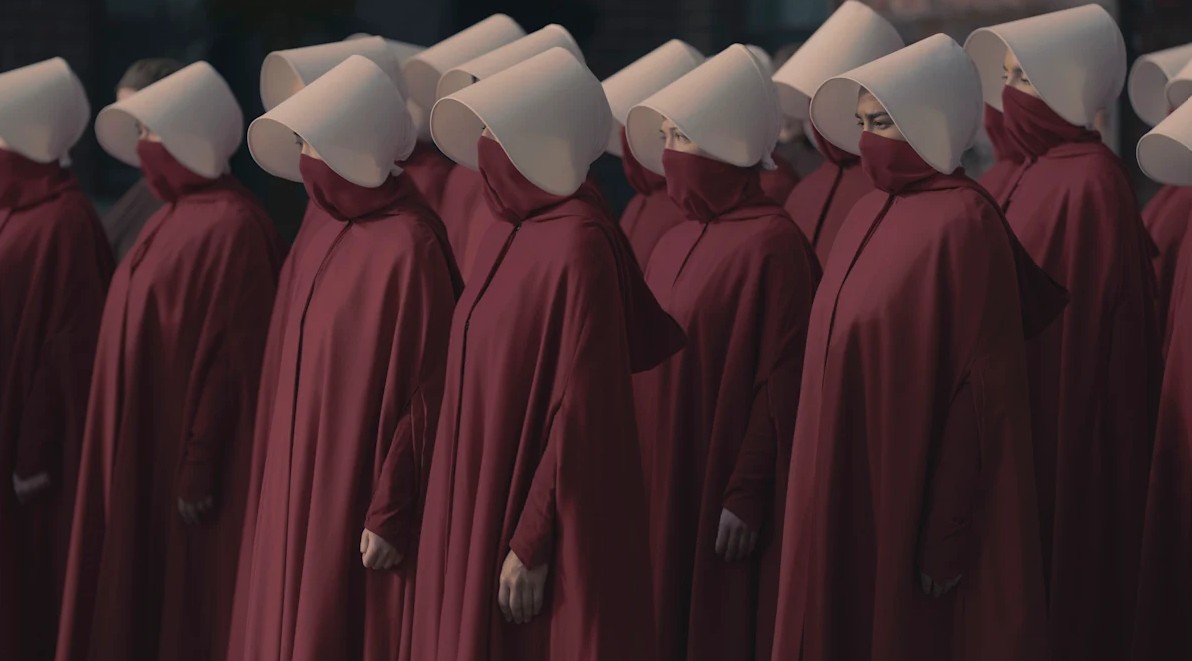
The Handmaids’ uniform is perhaps one of the most recognisable costumes in modern TV: long red dresses, white bonnets, and cloaks that render them nearly identical. Their individuality erased, they are reduced to fertile vessels that perform only one function — bearing children — and are denied any form of self-expression.


Unlike the Wives, Handmaids are not afforded subtle variations in the shade of red they wear, or through different dress styles. Their red dresses are identical in cut and colour, their bonnets, referred to as “wings” in the narrative, designed to restrict both their vision and their visibility.
This calls back to the key aspect of fascist Italy’s massaia rurale, whose individuality was also largely eroded through the dress code they were made to follow.


Ane Crabtree, the costume designer, has cited a blend of influences including 1800s frontier women, reaching even further back than the 1950s in her fashion history references. This perhaps makes the Handmaids’ dresses resemble an era when women’s freedoms were even more limited than during the 1950s, showing that while the Gilead wives’ rights and freedom are severely limited, the Handmaids are subjected to even more restrictions.


What does the Handmaid’s red dress symbolise?
- Fertility & Blood:
The red evokes menstrual blood, symbolising the Handmaids’ fertility, a rare and valuable resource in Gilead’s infertile society. Set against the mostly subdued and grey backdrop, they starkly stand out and draw both the viewers’ eyes and those of the characters within the show toward them. More generally, the red evokes the colour of blood, whether menstrual or not, and therefore also recalls the bloodshed that paved the way for Gilead to be founded in the first place.
- Desire:
Red is also the colour of passion, placing Handmaids in the realm of the sexualised other, marking them as objects of desire. It’s also a reference to Nathanial Hawthorne’s The Scarlet Letter: Handmaids may be fertile women, but they aren’t perceived as respectable due to the lives they led pre-Gilead. For example, June had an affair with a married man, resulting in a child, while Janine became pregnant outside of marriage and later had an abortion. Through their scarlet red uniform, like Hester Prynne in The Scarlet Letter, Handmaids are marked as sinners and ostracised, but, simultaneously, constantly sexualised.


- Anger, Rage & Resistance:
Red is a colour that evokes strong emotions, both positive and negative. It is also the colour of rage. Through June’s inner monologue, we see flickers of fury beneath the placid surface.

The Foundation of Gilead: The Madonna-Whore Complex
The rigid binary at the heart of Gilead’s gender politics is perhaps best understood through the lens of the Madonna-Whore complex, a framework in which women are either sanctified or sexualised, revered or reviled. In Gilead, this dichotomy is not only embedded in its foundational ideology, but enforced through dress: the Wives wear shades of teal, blue, and green — evoking the Virgin Mary in Christian iconography — while the Handmaids are cloaked in red, a colour long associated with sin, sexuality, and transgression. The result is a system in which women are split into opposites, each reduced to a single function: wife or vessel.

This division is most clearly illustrated in the deteriorating relationship between Fred and Serena Waterford. In flashbacks to the pre-Gilead era, Serena is a commanding public figure, an author and activist who speaks with conviction and charisma. Fred, by contrast, remains quietly supportive, often stepping in only to elevate Serena’s voice, not his own. His attraction to her seems rooted in her ambition, her intellect, and her non-conformity — qualities that, ironically, Gilead would later suppress.
But once Gilead is established and Serena is stripped of all professional agency, their marriage begins to wither. Now confined to the domestic sphere, Serena becomes the ideal Gilead wife: modest, obedient, and mute. And yet, it’s precisely this transformation that seems to estrange her from Fred. Their relationship turns cold, emotionally distant, and devoid of physical intimacy.
Fred, like many Commanders, begins to pursue the Handmaid in his household, which is at first implied with a previous Handmaid in the Waterfords’ household, then explicitly with June. Despite Gilead’s strict moral code, we see Commander after Commander engaging in illicit sexual relationships with the very women they label as impure. Meanwhile, their wives who are held up as paragons of virtue remain untouched. This double standard reveals the deep hypocrisy of Gilead’s theology: while women are sorted into rigid roles, men exploit both sides of the binary.
The costume design reinforces this power dynamic. The Wives’ attire draws from mid-century elegance and religious symbolism, their cool-toned dresses suggesting purity and control. In contrast, the Handmaids’ red uniforms flatten their identities and heighten their sexualisation, and function as both a warning and an invitation.
In the end, Gilead’s entire social order hinges on this binary fiction. But as The Handmaid’s Tale makes clear, these roles are not just reductive, they’re destructive. They unravel relationships, dehumanise women, and expose the insecurities of the men who cling to power by dividing the women beneath them.
Closing Thoughts on The Handmaid’s Tale Costumes
In The Handmaid’s Tale, the costume design is an integral part of the narrative. By drawing on historical precedents like the massaia rurale and la nuova italiana, the series underscores how fascist regimes, whether they’re real or fictional, use clothing to dictate identity, repress autonomy, and project power.
Ultimately, Gilead’s sartorial codes expose the fragility of the systems they uphold. The very uniforms meant to enforce order become visual symbols of resistance — particularly in the red of the Handmaids, which evokes both control and uprising.
They should never have given us uniforms if they didn’t want us to be an army.
— June Osborne, The Handmaid’s Tale

Leave a Reply