
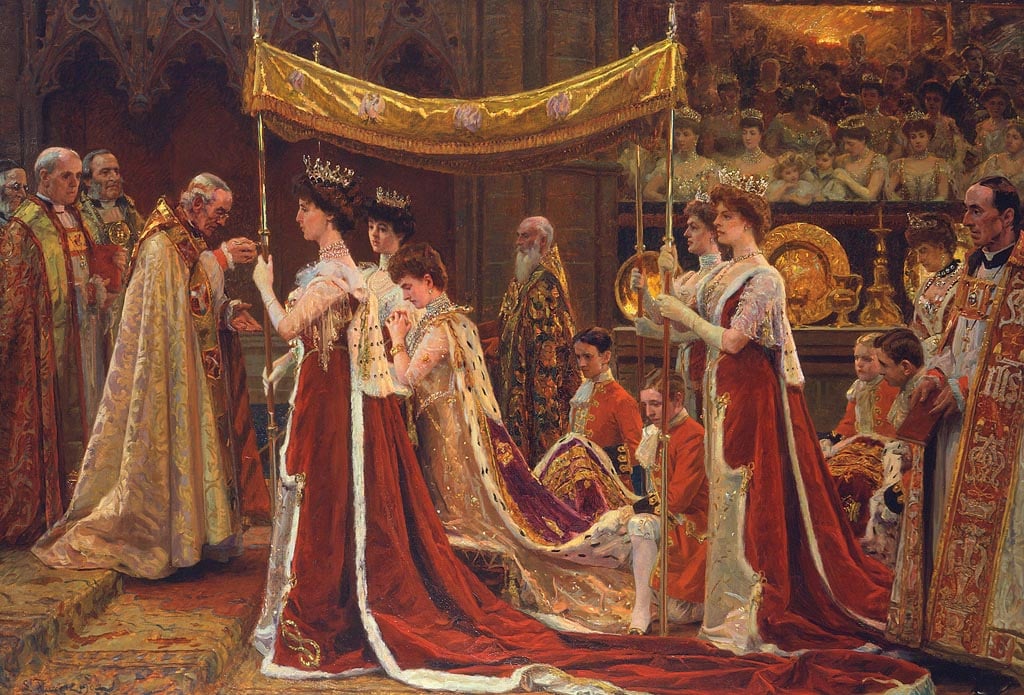
The coronation gown of Queen Alexandra, displayed in all its shimmering splendour at The Edwardians: Age of Elegance exhibition at The King’s Gallery, strikes you the moment you stand before it: Bathed in sombre serenity and markedly different from both the coronation gowns that preceded it and those that followed.
When Alexandra was crowned beside Edward VII in 1902, she ushered in a new sensibility that blended royal tradition with fashion-forward elegance and a degree of personal expression that feels almost unthinkable in the British Royal Family today. Her gown, glinting beneath the newly installed electric lights of Westminster Abbey, marked a turning point in the visual language of monarchy — one that had, for the better part of four decades, been draped in mourning.

In this article, we’ll explore how Alexandra’s bold design choices challenged coronation dress conventions, set a precedent for the queens who followed, and continue to resonate in the sartorial choices of today’s royal family.
The Glamour of a New Age
Alexandra of Denmark married the then Prince of Wales Albert Edward (King Edward VII) in March 1863. A year after their wedding, the popular German painter Franz Xaver Winterhalter, known for his flattering portraits of royalty, painted both Edward and Alexandra as they took the spotlight at the forefront of society and court life, while Queen Victoria remained in mourning for her late husband Albert.

Alexandra exudes elegance in Winterhalter’s portrait, which beautifully captures the multiple flounced layers of skirt and lace. Together, in their respective portraits, Edward and Alexandra represented a new generation of fashionable leaders, setting the tone of a new era that was coined ‘The Gilded Age’ across the pond in the United States.
It is only fitting then, that these portraits are how you start your journey through The Age of Elegance at The King’s Gallery that greets you with Winterhalter’s portraits of both Edward and Alexandra hanging side by side.
Even before their ascension, Edward and Alexandra heralded a new era for the royal family as leaders of fashion and focal figures in society; their lifestyle a string of garden parties, theatrical outings, sporting events, and fancy dress balls.

After decades of a monarchy in mourning due to Prince Albert’s untimely death in 1861, King Edward VII and Queen Alexandra, with their coronation in 1902, lead the monarchy into a vibrant new era with a court that reflected their own elegant and extravagant style.
“[Queen Alexandra is] the legitimate head of fashion throughout the British dominions.“
— Vogue
Queen Alexandra’s Coronation Gown
After Queen Victoria’s 40 years of mourning, the coronation of King Edward VII and Queen Alexandra was designed to be a public spectacle, with many unconventional choices and breaks from tradition.


Traditionally, a coronation dress would be a plain white or off-white (cream) gown, its simplicity echoing ecclesiastical robes and the solemnity of the occasion. For example, when Queen Victoria was crowned in 1838, she chose an understated cream satin gown with minimal embellishment.
But, Victoria had been crowned as a reigning monarch, not a consort, and by 1902, nearly a century had passed since a Queen consort had been crowned at Westminster Abbey, and so Alexandra had no direct precedent to follow, or recent visual script for how she should appear on such a stage.
Known as a fashion trailblazer and global fashion icon in her time, Alexandra was admired as much for her elegance as for her ability to set trends. For her coronation in 1902, she abandoned the expected palette of white or cream in favour of a dramatic, daring, and dazzling gold gown. It was designed by the female-led Parisian fashion house Morin Blossier, an unconventional choice that broke with the tradition of employing British designers for state occasions. Its surface shimmered with thousands of tiny gold spangles, meticulously arranged to catch and reflect the newly installed electric lighting in Westminster Abbey.
Kathryn Jones, the exhibition’s curator, noted that although the gown has darkened with time, contemporary accounts describe the moment Alexandra appeared as “an extraordinary blaze of golden light.” At a ceremony steeped in symbolism and structure, Alexandra staged her own theatrical moment of radiance, creating a striking image of a monarchy that was to balance tradition and modernity as they stood on the cusp of the 20th century: “A shining moment of glamour before the world was at war.”
Breaking with tradition while starting another
Although Alexandra’s coronation gown broke with many traditions, it also marked the beginning of a new one; one that endures to this day. At her suggestion, the national emblems of Britain — the rose, the thistle, and the shamrock — were incorporated into the gown’s embroidery, making it the first coronation dress to carry this botanical symbolism.
Forty needleworkers in Delhi spent five months embroidering the delicate gold net overlay with these emblems before the material was shipped to Paris to be assembled into its final shape. It’s a detail that has been echoed in every subsequent coronation dress, from Queen Elizabeth II’s gown in 1953 to Queen Camilla’s 2023 gown.
More is more: A moment of pure drama
The gown itself is a masterpiece of layered craftsmanship. A shimmering gold underdress is veiled by an ethereal net embroidered in silk thread and adorned with thousands of spangles. The silhouette is unusually structured and includes an open neckline trimmed with a ruff-like collar, which is possibly inspired by Tudor costume, but also evocative of Alexandra’s Danish heritage. The sleeves are another point of interest: one short, and the other layered with a longer, wing-like drape that added drama and movement.
The open neckline trimmed with a ruff-like collar of Alexandra’s dress could possibly be inspired by Tudor dress, as seen on Queen Elizabeth I’s Rainbow Portrait.
Source: Marcus Gheeraerts the Younger or Isaac Oliver, around 1600 (Hatfield Park).

Over it all, Alexandra wore a velvet mantle in a distinctive shade described as “petunia”. This, too, defied tradition: rather than a single royal cypher, as was customary, her mantle was embroidered all over with crowns and cyphers, following Danish royal custom.
The ensemble was completed with a dazzling display of jewels, creating a visual crescendo to an already opulent look. On state and formal occasions, Alexandra was known to wear layers of spectacular jewellery, often pairing multiple strands of pearls with diamond necklaces. For her coronation, she leaned fully into this aesthetic, adding to the gown’s already luminous effect. She famously set the fashion for high collars (which would define much of the Edwardian era) and tight-fitting choker necklaces, a style she initially adopted to conceal a small scar on her neck. Over time, it became one of her signature looks, imitated across Europe and cementing her status as a fashion icon.

Queen Alexandra, then Princess of Wales in 1893, wearing her signature jewellery look of stacked pearl and diamond necklaces.
Behind the Seams: Conservation, Restoration, and the Art of Display
Today, Queen Alexandra’s coronation gown is rarely displayed, and seeing it in person feels like a privilege made possible only through immense behind-the-scenes efforts. Its fragile condition is the result of both age and material complexity: the gold fabric, once radiant and bright, has darkened over time, with the exception of a few places inside folds. While gold alone does not typically tarnish, the metallic threads used in the gown were mixed with other materials, leading to gradual discolouration.
The most extensive conservation work focused on the delicate net overlay, which had developed multiple small holes. Conservators used a fine nylon conservation net to reinforce the damaged sections, placing it behind each tear and securing it with silk thread. The metal-thread lace collar designed to stand upright thanks to its wiring and decorated with faux pearls, gold-coloured beads, and glass stones, had also suffered wear. It was carefully stabilised using polyester thread.
To prepare the gown for exhibition, a bespoke mannequin was created to support its silhouette. Padding and petticoats were added to recreate the garment’s original volume and drape, allowing it to be admired as it would have been in 1902.
Alexandra’s Legacy: From Mary and Elizabeth II to Camilla
Edward and Alexandra were never afraid to break with tradition, and their coronation made that abundantly clear. For the ceremony in 1902, two thrones were commissioned not in Britain, but from the French firm Carlhian & Baumetz. Though adorned with British national symbols, the design followed the French style. Just a century earlier, the idea of an English king commissioning French craftsmanship for such a symbolic occasion would have been unthinkable.
Alexandra’s coronation gown, too, reflected the couple’s Francophile tastes. While the intricate net overlay was embroidered in India, the final construction of the dress was undertaken by Parisian couturier Morin Blossier. And yet, Alexandra’s sartorial decisions, though unconventional, also laid the foundation for a new tradition. At her suggestion, the national emblems of Britain — the rose, thistle, and shamrock — were embroidered into the gown’s design. It marked the first time this botanical symbolism was incorporated into a coronation dress, and it set a precedent that continues to this day.
Subsequent queens have embraced this legacy. Queen Mary’s coronation gown, created for her and George V’s 1911 ceremony, returned to a more traditional palette, with cream silk satin embroidered in gilt metal thread and decorated with tiny gilt metal beads. Alongside the national emblems of England, Scotland, and Ireland, Mary’s gown featured oak leaves and acorns, a wave motif symbolising the seas that connected the British Empire, the Star of India, and the lotus flower; a visual interpretation of Britain’s colonial overseas ties. The embroidery was undertaken by the Princess Louise Needlework School in London, while the robe was designed by British couture house Reville and Rossiter. In contrast to Alexandra’s French preferences, Mary’s ensemble was an entirely British creation: a telling reflection of shifting political moods and perhaps a quiet foreshadowing of the familial rifts that would soon divide Europe.


By the coronation of George VI and Queen Elizabeth (The Queen Mother) in 1937, the gown’s embroidery extended further still, symbolising the recently formed Commonwealth. The South African protea was one such addition.

The coronation of Queen Elizabeth II
These sartorial influences remained strong in 1953, when Queen Elizabeth II was crowned in a gown that shared the symbolic embroidery. Designed by Norman Hartnell, the dress featured emblems not only of the United Kingdom, but also of the seven independent Commonwealth realms of which Elizabeth was sovereign, including Canada, Australia, and New Zealand among others.
But while the motifs echoed her grandmother’s and mother’s dresses, the execution softened. The heavy gilt thread of earlier gowns gave way to softer gold and silver embroidery accented with pastel silks, seed pearls, crystals, and sequins, creating a lighter, more luminous effect that reflected a distinctly mid-century elegance.

In 2023, Queen Camilla’s coronation gown marked both a return to tradition and a personal influence. Made of ivory silk and embroidered in silver and gold, it carried forward the symbolic botanical motifs.


But Camilla’s gown also had a more personal touch: floral embroidery referencing her love of nature and the British countryside, and even the inclusion of her two dogs, stitched into the hem.
The impact on royal wedding dresses
Queen Alexandra’s 1902 coronation gown had a profound influence on the coronation attires that succeeded her own, but it also influences royal wedding dress design today.
In 2011, Sarah Burton at Alexander McQueen designed Princess Catherine’s wedding dress with hand-cut lace appliqué on the bodice and skirt, crafted by the Royal School of Needlework. Woven into the delicate lace were the national flowers of England, Scotland, Ireland, and Wales: the rose, thistle, shamrock, and daffodil.


A few years later, in 2018, Meghan Markle’s wedding veil became the centrepiece of her bridal ensemble. The five-metre silk tulle veil was embroidered with the floral emblems of all 53 Commonwealth nations in silk threads and organza.


Princess Eugenie followed suit later that same year, choosing a gown that featured thistles, shamrocks, and roses with ivy:


Princess Eugenie’s Wedding Dress 2018. Source: British Vogue.

Closing Thoughts on Queen Alexandra’s Sartorial Legacy
Queen Alexandra’s coronation gown may have graced the Abbey for only a single day in 1902, but its influence has endured for over a century. Her magnificent gold gown helped to rewrite the visual script for coronations of the British royal family by eschewing the ecclesiastical restraint of previous coronation gowns in favour of something unapologetically modern and unmistakably glamorous with a personal touch.
By introducing the embroidered national flowers on her dress, she began a new tradition. This language of floral embroidery has since adorned the gowns of queens and brides alike, threading its way through the coronations of Mary, Elizabeth, and Camilla, and into the wedding dresses and veils of modern royal brides.
It will be interesting to see how this tradition will be carried on in future, and how it may be disrupted again by future generations.

Leave a Reply