
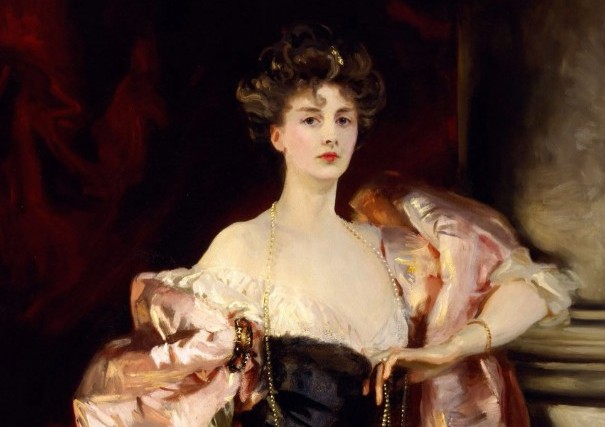
As the turn-of-the-century’s best-known portraitist, John Singer Sargent captured many of the era’s most prolific sitters, including aristocrats, industrialists, politicians, artists, and performers, who all formed part of his remarkable clientele. Yet Sargent was, and understood himself to be, far more than a painter of elegant likenesses. In many ways, he operated as an artistic director of public performance, someone who grasped the profound power of dress to communicate personality, social position, profession, gender identity, and nationality.
In his hands, portraiture and fashion blurred into a single expressive language. Sargent routinely departed from strict realism, exchanging what was in front of him for what served the portrait: Altering colours of gowns, removing details, or adding flourishes that his sitters never actually wore. So, it is an amusing contradiction that, although he is often described as the ‘chronicler of Gilded Age style,’ many of his canvases portray not literal truth but Sargent’s vision of it.
Even so, fashion in Sargent’s portraits remains foundational to how we understand Gilded Age fashion, from shimmering satin and starched taffeta to the carefully orchestrated silhouettes that defined Gilded Age dress style and the broader fashions of the era. His ability to translate fabric, movement, and attitude into paint is why Sargent’s women continue to fascinate us today.
To explore how and why Sargent and fashion remain closely linked — and to look more closely at some of his works — continue reading.
Sargent and Fashion: The Gilded Age
The Gilded Age is a period in American history that glowed with opulence but was underpinned by inequality. Spanning roughly from 1865 to 1902, the Gilded Age was a time of extraordinary economic expansion, thanks to industrialisation, railroad empires, and the rise of powerful magnates. Yet beneath the gilded surface lay rampant social injustice, political corruption, and sharp class and race divisions — It was an age of contradictions. It’s no surprise, then, that this era of American fashion history was equally layered, with fashion storytelling a key tool to signal status, femininity, and the performative power of wealth.
In Edith Wharton’s The Age of Innocence (1920), set in the 1870s, dress is described as “social armor” — a protective shell that can either bolster the wearer’s confidence or utterly undo it. Clothing, both in Wharton’s fictional world, and society in the latter half of the 19th century, is a visual declaration of status and wealth, qualities that mattered to be conveyed both in life and in portraiture.
Wealth and leisure — once the exclusive privilege of the aristocracy — were increasingly claimed by a new cosmopolitan elite. It is no coincidence that this was the moment when haute couture took shape in Paris, and when displays of luxury became central to defining one’s place in the social hierarchy. Thorstein Veblen captured this shift in The Theory of the Leisure Class (1899), introducing the concept of conspicuous consumption and devoting an entire chapter to “Dress as an Expression of Pecuniary Culture.” For this new class, acts of display had to be witnessed by peers to achieve their desired effect. Within this landscape, portraits occupied a uniquely powerful position. They functioned as an interface between sitter, artist, and public, offering a vehicle for self-fashioning. Fashion photography, still in its infancy then, could not yet compete with the reach and prestige of painted portraits. While fashion plates circulated trends through magazines, print reproductions of portraits played an essential role in showcasing both the latest fashion trends and the sitters whose social dominance they were meant to broadcast.
The fashions of the Gilded Age, even when subtly altered or wholly reimagined, were central to the storytelling power of Sargent’s portraits. His canvases may not always reflect sartorial reality, yet they reveal something very significant: How Gilded Age fashion, aspiration, and identity could be orchestrated through the artist’s and/or sitter’s eye.
A Brief Overview of Gilded Age Fashion
The silhouettes of the Gilded Age evolved dramatically with every passing decade. In the late-1860s, the elliptical crinoline cage was slowly phased out and gave way to the first bustle era of the early- to mid-1870s, with back-heavy skirts and elaborate drapery emphasizing a woman’s rear profile, and creating an exaggerated silhouette.

The excess of fabric used to create this silhouette, especially with all its added flounces, drapes, and other accents, made this style the prerogative of high society. The everyday woman could neither afford this late 19th-century fashion, nor was it practical. Thus, fashion and social status were intrinsically linked.

By the late 1870s, the bustle had gone out of fashion again, and dresses into the early 1880s returned to more natural, slimmer lines with tight-fitting silhouettes, and a fullness below the knees.
But, by the mid-1880s, the bustle was back with renewed vigor, more structured and sculptural than before, reaching its greatest proportions c. 1886–1888, as it extended almost straight out from the back waist to support a profusion of drapery.


The 1890s heralded the arrival (or revival) of the leg-of-mutton sleeves — perhaps among the most discussed dress elements in fashion history, and you either love it or hate it. The bustle also gave way, as the drama moved from (below) the waist to the shoulders with the sleeves and tall, tightly boned collars, creating a silhouette that emphasised broad shoulders and a cinched waist.
Fashion in Sargent’s Portraits
As the silhouette of Gilded Age fashion shifted from the sweeping drapery of the 1870s to the sculptural bustles of the 1880s and the bold, architectural sleeves of the 1890s, Sargent’s canvases evolved in tandem. His portraits function almost as a moving timeline of Gilded Age style, recording not just his sitters but the fashions that defined each decade.


The Paris Salon was the ultimate arbiter of artistic reputation in the late-19th century and where visitors came as much to see art as to see one another. Within the Salon, the portrait section had become the true spectacle. While history painting still carried more traditional prestige, portraiture and fashion dominated public interest. This was the arena in which would-be patrons surveyed the walls, debating which artist might best immortalise their own fashionable selves. To attract such clientele, painters needed to make their sitters radiant, modern, and unmistakably stylish, and were a visual promise that their work could confer both beauty and social cachet. Sargent excelled at exactly this; he made his sitters fit to be seen. Every choice of setting, pose, and costume became a carefully calibrated collaboration between artist and sitter. Yet in most cases, the decisive voice belonged to Sargent. He was the director, and his sitters generally followed his lead, including wearing garments he selected for them. But dress was never merely decorative. Fabric, silhouette, colour, and texture occupy vast stretches of his canvases, shaping the visual character of both sitter and picture. Ballgowns and evening dresses dominate many of his most famous works, but Sargent could conjure equal impact from the subtleties of day dress.
Women’s dress in the 19th century was highly coded, far more rigidly tied to time of day and occasion than it is today. Within Gilded Age fashion, wardrobes were divided into distinct categories: Day and walking dresses, gowns for visiting or social calls, dinner dresses, ball gowns, and informal tea gowns. Daywear, in particular, can be distinguished from evening dress by its higher necklines and covered arms; a convention clearly visible in Sargent’s portrait of Sarah Choate Sears, where propriety and refinement are signalled through restraint rather than display.


Evening wear, by contrast, allowed for a controlled unveiling. For formal dinners, receptions, and balls, women exposed more skin through lower necklines and bare arms.


By the turn of the 20th century, as women increasingly participated in more energetic pursuits and professional activities, fashion began to adapt accordingly. In Sargent’s works from the late 1890s into the early-20th century, tailored separates — skirts, shirtwaists, and structured jackets — appear with growing frequency. These garments reflect a shift within Gilded Age fashion toward greater mobility and practicality, and they underscore once again how closely Sargent and fashion evolved together, his portraits quietly charting broader changes in women’s lives through dress.

But it is his portrayals of professional women that reveal a different, less dazzling, side to Gilded Age fashion. Figures such as Elizabeth Garrett Anderson — one of the first women to practice as a doctor in Western history — and Jane Evans, who ran a boarding house at Eton, appear in more austere workday clothing rather than couture. These portraits underscore Sargent’s ability to navigate the full spectrum of the fashions of the Gilded Age, from opulent society gowns to garments that signalled vocation and purpose rather than luxury.

In his portrait of Jane Evans, Sargent presents his sitter in a black wool suit that draws unmistakably on menswear, softened by the addition of large leg-of-mutton sleeves fashionable at the time the portrait was painted. The tailored severity of the suit sets Evans apart from many of Sargent’s other female sitters, whose clothing more typically adheres to the softer, conventionally feminine silhouettes associated with Gilded Age style.

The Foreign-Born Parisienne
By the late-19th century, Paris had firmly established itself as the epicentre of fashion. Members of the global elite flocked to the city to commission couture gowns and refine their wardrobes, which could then be displayed both abroad and at home. With Paris the symbolic capital of Gilded Age fashion, women of many nationalities aspired not merely to wear French dress, but to embody Frenchness through style. Sargent was acutely aware of this dynamic, and his portraits frequently participate in the creation of national identity through dress. His sitters were not only depicted as fashionable women, but as women carefully styled to signal belonging within a particular cultural hierarchy. In this sense, Sargent and fashion converge as tools of transformation: Clothing becomes a means of self-fashioning and of claiming social legitimacy.

Amalia Errázuriz (Madame Ramón Subercaseaux), a Chilean socialite, offers a compelling example. Sargent painted her in a crisp white afternoon dress with a long, buttoned bodice and a flounced skirt trimmed with black velvet, ribbon, and lace. Every element of the composition is orchestrated to reinforce elegance. Sargent arranges her train with particular care, allowing it to cascade across the floor in rhythmic blacks and whites that echo the surrounding interior; the black piano case and chair, the ivory keys, the pale walls, and the delicate flowers.
When the portrait was exhibited in 1881, many visitors mistook Madame Ramón Subercaseaux for a Frenchwoman; a misidentification that served as a profound compliment to both sitter and artist. Here, portraiture and fashion operate as instruments of cultural assimilation, allowing a foreign-born woman to pass convincingly as Parisienne through dress, posture, and environment alone.
This act of sartorial transformation finds its most famous — and controversial — expression in Sargent’s portrait of Virginie Amélie Avegno Gautreau, better known as ‘Madame X’. American-born and married to a French banker, Gautreau consciously fashioned herself into a society figure in Paris, using her appearance as a means of social advancement. Sargent understood that her toilette was not incidental but essential to her constructed identity, and he made fashion central to the portrait’s narrative.

The dress Gautreau wears was widely discussed in contemporary reviews. While its low neckline was not, in itself, unprecedented — other Salon portraits, including depictions of actresses and opera singers such as Caroline Salla, featured similarly plunging cuts — it provoked scandal because Gautreau was a woman of society. What was acceptable for performers became transgressive when worn by someone who claimed Parisian respectability.

The outrage crystallised around a specific detail: The jewelled strap of her black evening gown slipping from her shoulder. This fleeting gesture, intended to suggest modernity and allure, was interpreted as vulgar provocation. Critics objected not only to the exposed skin but to what it implied: A lack of proper undergarments, a breach of decorum, a failure of taste. As one reviewer put it, the neckline and its silver chains gave “the impression of a dress that will fall.”
In this moment, Gautreau’s carefully cultivated Parisian identity unravelled. Arsène Houssaye (French novelist and poet) had proposed in 1867 that a woman could be Parisienne either by birth or by dress; ‘Madame X’ fell into the latter category. Yet her performance as a “professional beauty” — a term used to describe women raised to captivate — ultimately exposed her foreignness rather than concealing it. The fallen strap became a symbol not of daring elegance, but of social miscalculation: A mistake that a true Parisienne would never have made.
After the Salon closed, Sargent repainted the strap in its upright position, an attempt to temper the damage. But the fashion faux pas had already been immortalised. Here, Sargent portraits reveal the fragility of self-fashioning; while dress could elevate, it could also betray. Fashion, here, becomes a volatile marker of national identity, social belonging, and the precarious boundaries between insider and outsider.
The Intersection of Art and Fashion in Sargent Portraits
In 1863, Charles Baudelaire argued that for a painting to be truly modern, it must capture the fashions of its own time. He went so far as to liken a well-dressed woman to a work of art; an idea that resonates in the portraits of John Singer Sargent. Few artists of the late-19th century understood dress not merely as ornament, but as an expressive medium capable of conveying modernity, taste, and cultural relevance.
Throughout his career, Sargent and fashion were deeply intertwined. His portraits demonstrate a keen awareness of contemporary Gilded Age fashion and an ability to present his sitters to their best advantage, translating fabric, silhouette, and surface into painterly language. A striking example is his portrait of his friend Charlotte Louise Burckhardt, known as Lady with the Rose. She is dressed in a black crinoline ensemble, including a colossal bustle, that dominates her silhouette. Sargent’s technical sensitivity is especially evident in his handling of the sheer cut-outs at the bodice: A barely visible, gauzy layer is suggested through paint alone, creating an illusion of transparency that feels uncannily lifelike.

This intersection of art and fashion finds a compelling parallel in the work of Charles Frederick Worth, often referred to as the father of haute couture, who consciously cultivated the image of the couturier as artist. Worth styled himself accordingly and observers described his creative process in distinctly artistic terms. One 1863 account likened his manipulation of taffeta to modelling clay, noting how he would drape fabric on a client’s body before stepping back to assess the effect — much as Sargent was known to apply paint to canvas and then retreat to judge the composition. Worth himself famously declared,
“I have Delacroix’s sense of colour and I compose. A toilette is as good as a painting.”
The Shared Language of Art and Dress
By the late-19th century, the boundaries between art and dress had begun to blur, not only in practice but in language. Critics increasingly relied on the vocabulary of fashion to analyse and describe paintings. This linguistic overlap would come to shape critical responses to Sargent portraits, particularly to imply that Sargent’s focus on dress in his portraits made his work less valuable.
George Moore’s review of Sargent’s portrait of Mary Frances Grant is a telling example. Writing in the language of the fashion world, Moore implied that Sargent’s emphasis on surface and style undermined his seriousness as a painter. Such criticism taps into a long-standing cultural hierarchy in which fashion — so closely associated with femininity and consumption — was regarded as merely decorative and not worthy of intellectual study.

This attitude recurs in the responses of other contemporaries. D. H. Lawrence dismissed Sargent’s portraits as “nothing but yards and yards of satin from the most expensive shops, having some pretty head propped up on the top,” while Walter Sickert accused him of placing too much emphasis on dress and the sensual rendering of fabric. In these critiques, portraiture and fashion become entangled in a shared accusation: Sargent was framed as a “slave to fashion,” his paintings reduced to commodities. The language mirrors how women themselves were often discussed in the period as decorative objects, designed to adorn the drawing room, thus underscoring how deeply gendered these dismissals were.
Fashion in Print: The Rise of the Illustrated Fashion Press
At the turn of the 19th century, the production and circulation of fashion and trends was undergoing significant transformation. Clothing was still overwhelmingly custom-made, whether commissioned from a dressmaker or tailor, or constructed at home from personally sourced fabric. When Sargent began his career in Paris in the 1870s, haute couture was only just emerging. Dressmakers and tailors were plentiful, and many of Sargent’s sitters frequented the finest establishments in London and Paris. The garments that appear in his portraits were therefore never incidental; they were carefully chosen or specially made, often with the portrait itself in mind. In this sense, sitting for Sargent mirrored the collaborative process of dressmaking, with aesthetic intention shaping the final result.
The fashion press played a crucial role in extending the reach of these styles beyond elite social circles. Advances in printing made women’s magazines more widely accessible, and publications such as The British Ladies’ Gazette of Fashion and the German Die Modewelt circulated Parisian designs across national borders. Sargent portraits entered this visual ecosystem through reproduction, appearing alongside fashion illustrations and, later, on the covers of magazines such as Les Modes. These images were frequently cropped to emphasise the gown, treating the portrait less as documentation of a painting and more as fashion inspiration.
One contemporary observer noted in 1878 — just a year after Sargent’s successful Paris Salon debut with the portrait of Fanny Watts — that “there is now a class who dress after pictures, and when they buy a gown ask, ‘will it paint?’” The remark neatly captures a moment in which John Singer Sargent and fashion operated within the same visual economy. Art shaped dress, dress shaped art, and fashion magazines became key arbiters of taste. That some critics struggled with this convergence tells us less about Sargent’s limitations than about the cultural unease surrounding fashion’s growing authority within fashion in art history.
Gilded Age Fashion Reimagined: Sargent’s Aesthetic Control Over Dress
John Singer Sargent once described himself as both a painter and a dressmaker, a remark that speaks directly to his approach to fashion within portraiture. While his sitters often arrived with garments drawn from their own wardrobes, what ultimately appears on canvas is rarely a straightforward record of what was worn. Instead, Sargent portraits reveal fashion as something selected, rearranged, and subtly reinvented to serve the demands of picture-making, turning dress into a compositional tool rather than documenting fashion history factually.
This process begins with selection. Sargent said that he preferred dresses already in existence, yet reality, to him, was flexible. One sitter, Gretchen Osgood, reportedly wore a gown borrowed from a sister-in-law several sizes larger, which Sargent selected due to its pink hue, but required significant arrangement due it being too long for the sitter. Her daughter, who was painted with her, was merely draped in a plain piece of pink cloth that was pinned into position.


In the portrait of Helen Vincent, Sargent famously scraped out a white dress he found unsatisfactory and replaced it with a striking black garment: What mattered was not accuracy, but suitability to his artistic vision.

Sargent freely pinned, twisted, and fluffed garments to animate their surfaces and create visual drama. Opera cloaks were secured to reveal vibrant linings; silk wraps, chiffon scarves, and shawls were added or repositioned; jewellery was draped across bodices or removed entirely. In the portrait of Lady Sassoon, the black silk taffeta cloak is arranged so that its pink lining forms a diagonal river of colour across the composition; an effect that could only have been achieved by turning and pinning the garment against the body. Comparing the painting with the surviving cloak confirms the extent of this manipulation.

Sargent regularly altered decorative details, changing their scale or selectively omitting them altogether. In portraits where original garments survive, such as the opera cloak of Lady Sassoon, it becomes clear that smocking, scallops, or layered trims were simplified or removed, while new ornamental elements were sometimes added to heighten lightness or rhythm. This practice underscores that Sargent was never attempting to catalogue dress construction. Instead, he sought to evoke the tactility of textiles, allowing seams to disappear and layers to merge under the fluidity of his brushwork. Broad, liquid strokes lend themselves especially well to silk and satin, creating shimmering surfaces that suggest weight, sheen, and movement. In the portrait of Eleanora O’Donnell Iselin, deep black brushstrokes layered over grey undertones give the sleeve the lustre of silk satin, while tiny flecks of white paint stand in for light catching on discreet jet or sequin embellishments. Even the sitter’s white linen cuffs — painted translucent against opaque black.

Colour, too, was subject to Sargent’s control. He favoured monochromatic black and white, editing out potentially distracting ornamentation. While black retained associations with mourning throughout the 19th century, its use in fashion expanded significantly by the 1880s, aided by the development of deep aniline black dyes. Fashion periodicals of the era make clear that black was widely worn for both day and evening dress, often richly decorated. Sargent’s many depictions of women in black (nearly half of his female sitters during the 1880s) reflect both contemporary fashionability and his love of the colour’s dramatic impact. That sitters such as Mrs Iselin were not in mourning only reinforces that Sargent’s choices were aesthetic rather than symbolic.

Patterns, by contrast, appear rarely in his work. Like many artists before him, Sargent followed a long tradition of simplifying textile surfaces to prevent pattern from overwhelming the sitter. Plain fabrics were quicker to paint and more effective at capturing light. This paints a very monochrome picture of Gilded Age fashion; one that does not represent the reality of dress in the late-19th century. With the production of fashion becoming ever more industrialised and the rise of haute couture, many dress patterns and colours were bold, even if Sargent made the artistic decision not to portray them. Exceptions, however, do exist — most notably in the portrait of Mary Louisa Cushing.

Crucially, Sargent never worked without real garments in front of him. His inventions were grounded in material reality, even when transformed on canvas. What his portraits offer, then, is not a transparent record of dress, but a vision of fashion shaped by artistic intention. In the context of fashion in art history, this selective manipulation complicates the charge that Sargent was merely a recorder of luxury or a “slave to fashion.” Instead, it reveals an artist who understood fashion as a powerful visual language — one he could edit, subdue, and elevate to serve the demands of art.
Sargent’s Influence Today
John Singer Sargent’s influence did not end with his death, nor with the passing of the world he so vividly captured. That his work continues to be referenced across fashion imagery and visual culture today is perhaps the clearest measure of its lasting power. From fashion editorials — most notably Vogue’s 1990s evocations of Sargent portraits — to costume design in period dramas such as The Forsyte Saga (2002), and more recently HBO’s The Gilded Age (2022 and still going), Sargent’s distinctive approach to dress continues to shape how fashion is visualised on screen and in print. These modern reinterpretations draw directly on the visual language established through fashion in Sargent’s portraits, long after both painter and sitters are gone.
Nicole Kidman Starring in the Role of Sargent’s Famous Sitters
In June 1999, Vogue featured Nicole Kidman on its cover in a fashion editorial that overtly engaged with the visual language of John Singer Sargent and fashion. Photographed by Steven Meisel, the series positioned Nicole Kidman as a modern embodiment of several of Sargent’s most recognisable sitters, including the infamous ‘Madame X’. Some of the images function as near-direct recreations of Sargent portraits, carefully echoing pose, lighting, and silhouette, while others draw more loosely on Sargent’s aesthetic, translating his painterly vision into the idiom of late 20th-century fashion photography. Together, the editorial demonstrates the continued relevance of fashion in Sargent’s portraits, showing how his approach to surface, pose, and self-fashioning remains legible and compelling within contemporary visual culture. In the gallery below, I have placed several of these images alongside their painted counterparts for closer comparison.


This is likely where the Vogue photoshoot diverges most from its source material. Beyond the setting and the loosely inspired pose and drape of the garments, the photo shares little directly with Sargent’s original. Yet the way the black fabric is draped over Nicole Kidman’s arms, along with the ribbon/bow at her shoulder, strongly echoes the manner in which Sargent arranged clothing on his sitters. These compositional touches can be traced throughout his work.


Sargent Portraits as Inspiration for On-Screen Costumes
Costume designers draw inspiration from a variety of sources, including surviving garments from the period, fashion plates, personal diaries detailing clothing, and photography from the mid-19th century onwards. Portraiture is another key reference point, and for those designing costumes set between the 1880s and the early 1900s, John Singer Sargent’s portraits naturally stand out as a rich and compelling source of visual inspiration.
In the 2002 ITV series The Forsyte Saga, Gina McKee as Irene Forsyte wears two gowns that are unmistakably inspired by Sargent portraits, with only minor alterations to colour, fabric, and accessories.


For The Forsyte Saga, costume designers chose to change the black of Madame X’s dress to red — a cliché visual shorthand for an adulterous woman (but if it ain’t broke, don’t fix it I guess?). Interestingly, in one of the series’ promotional images, the jeweled strap of Irene’s dress is shown slipping off her shoulder, echoing Sargent’s original painting before he altered it following the Paris Salon’s criticism. Like Madame X, Irene is ultimately judged by society for her choices and actions.


Kasia Walicka-Maimone, costume designer for HBO’s The Gilded Age, has cited portraiture as a major source of inspiration for the series’ depiction of the fictional New York high society in the series. Sargent even makes a cameo in season 3, when Bertha Russell commissions him to paint her daughter Gladys’s portrait. This plot point has sparked debate among viewers, as Gladys’s costume in the “Sargent” portrait is actually inspired by a different artist, and the finished on-screen painting bears little resemblance to an authentic Sargent, at least in the eyes of many fans.


In Conclusion: The Art of Being Fashionable
John Singer Sargent’s portraits endure because they exist at a productive crossroads: between art and fashion, truth and performance, individuality and social expectation. His sitters are staged for public consumption. Fashion, in his hands, becomes both material and metaphor — a language through which identity, ambition, gender, and national belonging are articulated and, at times, contested. That his work continues to shape how we visualise the Gilded Age speaks not to documentary accuracy, but to his extraordinary ability to distil the essence of an era through dress.
His portraits reveal how fashion operates as a system of power: Capable of elevating, disguising, disciplining, or exposing those who wear it. That this visual language remains legible today, reappearing in fashion editorials and on-screen costume design, confirms Sargent’s lasting influence. His work continues to inform how we imagine elegance, modernity, and status at the turn of the century, long after the world he painted has vanished.


For more from A Study in Style, including looks and insights that didn’t make it into this article, follow me on Instagram @astudyinstyle_threadsofmeaning. I share extra details about the garments I analyse in all my articles, along with glimpses from exhibitions and museum visits.
Leave a Reply