
James Cameron’s 1997 film Titanic is one of those enduring screen stories that continues to captivate audiences. More than a century after the ship’s tragic sinking, its legend still holds a powerful grip on our collective imagination.
For me, Titanic was likely one of the first period films I ever saw, and the breathtaking costumes by Deborah Lynn Scott left a lasting impression. I remember rewinding the VHS tape (remember those?) to linger in the calm before the storm when the screen was filled with ‘all those pretty dresses.’ To this day, the early 1910s remains one of my favourite fashion eras.
So, let’s dive in (pun not intended) and take a closer look at some of the Titanic costumes that truly altered my brain chemistry. How do they reflect the Edwardian fashion timeline, and just how historically accurate are they?
Edwardian Era Fashion Timeline
Edwardian fashion marked a transitional moment in women’s dress, bridging the elaborate styles of the late Victorian period and the streamlined elegance of the early 20th century. While 1910s fashion initially retained features from the previous decade, it gradually moved toward simpler lines and a softer silhouette compared to the decade before, which was dominated by the so-called “S-curve.”

The S-shape of Early Edwardian Fashion
The early 1900s were dominated by the dramatic S-curve silhouette, a hallmark of Edwardian ladies’ fashion. This look was achieved through rigid corsetry that pushed the bust forward and the hips back, creating a “S” shape. The aim was to accentuate a small waist and a pronounced “mono-bosom”. This exaggerated form was further reinforced by loose blouses (see right image), which added volume to the upper half of the body. As seen in fashion plates from the early 1900s (see left image), this structured aesthetic defined the early phase of Edwardian female fashion.


Fashion in the 1910s: A Shift towards Simplicity
By the 1910s, women’s fashion began to embrace a more natural, columnar silhouette. It saw the S-curve give way to straighter lines and a narrower shape. While the look was more relaxed, corsets were still a necessary foundation; though now redesigned to support a higher waist and a more vertical posture. These garments helped create the “pillar” look of 1910s women’s fashion, often complemented by narrower skirts that tapered at the hem. Echoing the neoclassical influence of a century earlier, many gowns of the time featured a softened empire waistline, nodding to early 19th-century styles, which themselves took inspiration from the antiquity. This streamlined elegance defined much of the 1910s in Western fashion.


Titanic Costume Analysis
Let’s take a slightly different approach this time. Rather than analysing each look and building up to a conclusion about historical accuracy, I’ll start with my verdict: the Titanic movie costumes are a triumph of period design. Drawing directly from original 1910s fashion plates and extant garments, the wardrobe created by Deborah Lynn Scott achieves a level of authenticity that sets it apart. As part of this thoughtful design, we even catch a glimpse of the foundational undergarments worn by Kate Winslet, which are essential elements in shaping the correct Edwardian silhouette on screen.
That said, not everything holds up to the same historical scrutiny. The major concession to contemporary aesthetics lies in the hair and makeup, which are unmistakably 1997 rather than 1912. While this doesn’t detract too much from my enjoyment of the film, it’s a common pitfall in period dramas: even when the clothing is perfectly accurate, the beauty standards of the film’s production era tend to creep in. A prime example is Gone with the Wind (1939), in which the styling unmistakably reflects 1930s glamour more than mid-19th-century reality. Similarly, the makeup in Titanic reveals its late-’90s roots. Rose’s lipliner is one of the most noticeable giveaways. Though commercially produced cosmetics did exist at the time — Max Factor opened in Los Angeles in 1909 — daily use of makeup was still largely confined to actresses and music hall performers. Products like eyeshadow, mascara, and lipstick wouldn’t be widely worn in everyday settings until the 1920s.
Boarding the Ship of Dreams
Our first glimpse of Rose DeWitt Bukater is absolutely iconic cinematography: framed in an opulent wide-brimmed hat, she lifts her gaze to meet the audience, and the ship. It’s a beautifully composed scene, and one that immediately signals both character and era.


These oversized hats were quintessential in Edwardian ladies’ fashion, often secured with long hatpins and lavishly adorned with artificial flowers (like the example in the image below), feathers, and ribbons. The hat Rose wears, trimmed with an oversized bow, may seem theatrical, but similar styles can be found in fashion plates and museum collections from the early 1910s.
Her ensemble is equally rooted in period accuracy. The tailored purple and white suit she wears when boarding the RMS Titanic is a near replica of an afternoon suit designed by Linker & Co., photographed for Les Modes in January 1912. Side by side, the resemblance is striking. Deborah Lynn Scott made a few subtle adjustments: the buttons on the original suit appear slightly larger, for example, and the costume version adds buttons to the lower part of the skirt and matches the lapels to the waistband in colour. These small changes do not detract from the overall authenticity. In fact, they reflect a costume designer’s balancing act between faithfulness to historical garments and visual storytelling.


1912 Women’s Fashion: Dining in Splendour
I was tempted to call Rose’s dinner dress the most memorable look in the film, but after revisiting her boarding ensemble, it’s clear that choosing a single standout from the Titanic movie costumes is no easy task. Still, this richly beaded gown is often cited as a fan favourite, and I can see why.

Costume designer Deborah Lynn Scott appears to have drawn inspiration from an original early 1910s fashion design for this striking look. The layered, slightly asymmetrical net overskirt, draped over satin, closely resembles a 1910 dinner dress by House of Worth.

The parallels are clear: both gowns feature delicate metal thread embroidery, crystal detailing, and silver bugle beads. The key difference lies in the palette. While the Worth gown contrasts a light skirt with a rich red velvet bodice, the Titanic costume opts for a uniform tone, likely achieved by a black net overlay atop a terracotta silk base, which creates that distinctive deep burgundy hue. Scott also altered the sleeves, omitting the original elbow-length drape to allow the opera-length gloves their dramatic spotlight.
Though not my personal favourite among the Titanic costumes, this look’s historical inspiration by House of Worth is one of my personal Edwardian fashion history standouts. And clearly, it held a special place for Scott as well, because Rose wears another, white version of the same gown in the film’s final scene.


While I might have enjoyed seeing a new design here, the reuse makes narrative sense. The film’s ending is deliberately open to interpretation for viewers to decide whether Rose dies and reunites with Jack in the afterlife, or simply dreams of this sequence. Because the setting atop the grand staircase mirrors the evening of the formal dinner, when she first wore the original gown, her reappearance in a ghostly white version of the same dress anchors the moment in the memory of the past, making it a deeply symbolic choice within the narrative.
I’m Flying, Jack
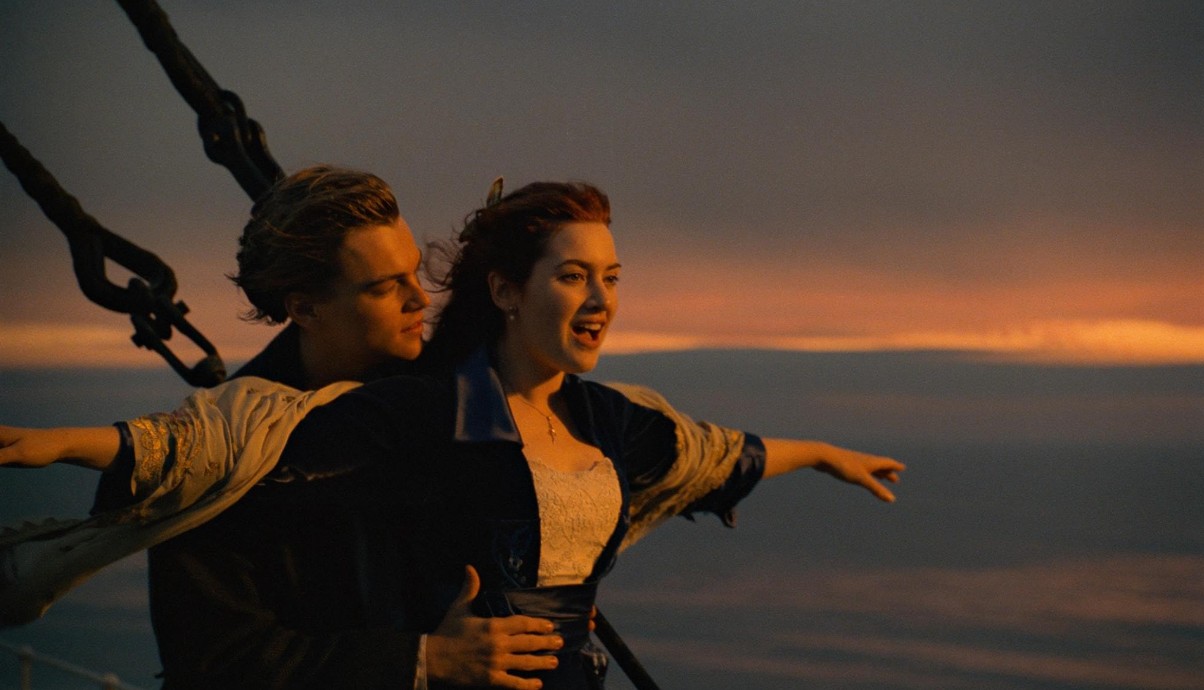
Leaving my favourite for last, we come to what is often called the “flying dress”. I’m, of course, talking about the ethereal ensemble Rose wears during her iconic moment with Jack at the bow of the ship. It’s the look everyone tries to recreate the minute they set foot on a boat😉.


The combination of this gorgeous shade of blue and cream, complete with delicate lace details, tassels, and subtle embroidery, stole my heart the first time I saw it, and it’s never let go. To this day, it remains my undisputed favourite among all the Titanic movie costumes, and easily ranks in the top five of my all-time favourite film costumes.
If the silhouette looks familiar, it’s because it mirrors the shape and layered structure seen in 1910s fashion plates like those from L’Art et la Mode which we’ve already seen earlier.
The dress features a two-tiered skirt created by the base layer and a coat-like overdress, with side drapes and an open neckline, elements that became more common in 1912 women’s fashion in afternoon wear.


Even the use of tassels is historically grounded, appearing frequently in original garments from the period, like this Lucille evening dress from 1912.
“Orientalism” in Edwardian Fashion
One important stylistic development during this time was the influence of “Orientalism” on Edwardian era fashion, especially after the Ballets Russes’ 1910 Paris performance of Schéhérazade (based on One Thousand and One Nights). This ushered in a wave of “exoticised” aesthetics across 1910s women’s fashion, particularly through the work of Paul Poiret (French fashion designer and couturier), who popularised the columnar silhouette, rich textiles, and fluid draping.
While Rose’s “flying dress” doesn’t explicitly reference “Orientalist” fashion, it evokes a similarly romantic sensibility. The floral embroidery and the loose, flowing jacket-like top suggest a gentle nod to Japanese design reminiscent of the kimono. While not a direct replica, the look reflects the broader cultural influences shaping fashion in the 1910s, and offers a perfect example of how Edwardian female fashion interpreted global aesthetics through a Western lens.


Left: Fancy Dress Costume by Paul Poiret, 1911 (The Metropolitan Museum of Art).
Right: Denise Poiret at the 1002 night party held by Paul Poiret in 1911.
Note: The 1910s fashion trend “Orientalism,” drew inspiration from the “Orient” (referring to the Middle East, Asia, and North Africa), presenting it as exotic and alluring. When talking about these fashion influences today, we need to be aware of how problematic this is, as it often involved misrepresenting and simplifying diverse cultures, perpetuating stereotypes, and reinforcing Western perceptions of superiority.
Necklines in 1912
Necklines in the Victorian era and in the early 1900s could serve as a clear indicator in sartorial analysis of a garment’s purpose and time of day. Day- and evening wear could be clearly distinguished by neckline and sleeve length: high necklines and long sleeves were standard for daytime attire, while open or off-the-shoulder necklines appeared in evening gowns. In early Edwardian fashion, high, often boned collars, and typically adorned with lace, were a signature feature, particularly on popular tea gowns and blouses. However, by 1910, and especially throughout 1911 and 1912 fashion, more relaxed, collarless necklines began appearing even in daywear, reflecting broader shifts within 1910s fashion. These more open necklines were increasingly accepted, especially in spring and summer, marking a transition in the silhouette and modesty expectations that characterised fashion in the 1910s and the evolving role of women in society.
In Titanic, this distinction is subtly but meaningfully used in the costume design. Rose’s afternoon ensembles frequently feature lower, more open necklines, while most other women, such as her mother or Mrs. Brown, are dressed in high-collared lace typical of Edwardian ladies fashion. This seems a deliberate narrative decision by the costume department, signaling more than just aesthetic variation.


There may be two underlying reasons for this visual contrast:
- Youth – At 17, Rose’s more open necklines visually separate her from the older women aboard the ship, emphasising her youth and transitional position between girlhood and adulthood.
- Characterisation – The lower necklines may symbolise Rose’s emotional openness and inner conflict with the restrictive world she inhabits, in contrast to the more closed-off, controlled personas around her.

The one notable exception is the outfit Rose wears when boarding the Titanic: a tailored suit with a buttoned-up blouse and tie. This ensemble starkly contrasts the openness of her later looks, and visually reinforces the restrictive life she’s trying to escape. As Rose reflects in her voiceover: “To me, it was a slave ship, taking me back to America in chains” (setting aside the problematic nature of that comparison). It’s a subtle yet effective example of how Titanic movie costumes contribute to character development, while also reflecting the broader shifts within Edwardian fashion history and 1912 women’s fashion.
Undergarments: The Flowy Gowns Were in No Way a Reflection of More Relaxed Corsets
The fashionable silhouette of 1912 women’s fashion relied on a carefully structured foundation of undergarments. Just as we explored the dramatic “gigot” sleeves and voluminous skirts in my analysis of the Nosferatu costumes, here we must consider what shaped the more streamlined styles of the early 1910s fashion era.
In Titanic, we move forward about 55 years from the Victorian silhouettes of Nosferatu to a very different moment in fashion history. The exaggerated curves of the early 1900s, which were defined by the S-bend corset, had begun to soften. By 1912, a narrower, column-like shape had taken hold. Though visually more relaxed, this aesthetic still required deliberate shaping underneath.
As mentioned earlier in this article, the Edwardian era fashion timeline saw a shift from the heavily structured, bust-forward S-curve to a silhouette that emphasized length, verticality, and a raised waist. These changes in Edwardian female fashion influenced the design of corsets during the period.
When we think of corsets, many of us imagine the hourglass-shaped, whaleboned styles of the mid- to late-19th century, such as this lace corset from England or Germany (ca. 1895–1900).


But to achieve the elongated, columnar silhouette popular in the 1910s, a completely different type of corset was required. For example, this corset by Rocher (ca. 1908–1910) shows a garment designed to shape the hips and lower abdomen while allowing for a straighter line through the torso.
By 1912, corsets extended well below the waist and sometimes even reached the thighs, flattening the stomach and narrowing the hips, which was essential for achieving the signature look of Edwardian ladies fashion. (See the W.B. Reduso advertisement from the U.S., ca. 1912.)


In Titanic, we get a valuable glimpse of period undergarments in the scene where Rose is laced into her corset by her mother. It’s a common trope in historical films: the corseted woman gripping a bedpost while someone tugs mercilessly at the laces (don’t get me started 🌚). That said, credit where it’s due: Rose is shown wearing a shift underneath, rather than placing the corset directly on her skin (a mistake far too many period films make).
This scene offers a key moment to observe the structural underpinnings required to convincingly portray 1912 women’s fashion. But how accurate is the corset itself? In short — somewhat.
The design does follow the elongated line from waist to thigh, supporting the pillar-like silhouette typical of Edwardian era women’s fashion. From the waist down, the garment aligns with what we see in period illustrations and advertisements. However, the upper portion is less convincing. After reviewing numerous fashion plates and records from the period, I couldn’t find a single overbust corset from the early 1910s. That said, 1910s corsets weren’t exactly underbust either — the bust area was simply cut low, allowing for support without coverage.
Additionally, in stills from an exhibition featuring the Titanic movie costumes, the way the fabric creases around the bottom looks slightly off. It lacks the smooth stiffness seen in authentic period pieces. It’s a small, nit-picky detail, but one that stands out in close Titanic costume analysis.

Summing Up Edwardian Fashion in Titanic
The beauty and surprising historical accuracy of the Titanic movie costumes make them truly unforgettable. Their visual alignment with the film’s central themes of transformation, constraint, and release adds depth to the already compelling representation of 1910s fashion. Deborah Lynn Scott’s designs may take occasional liberties with Edwardian fashion history, but they succeed in capturing the essence of 1912 women’s fashion and the transitional elegance of the 1910s in Western fashion.
From the tailored boarding suit that mirrors Rose’s sense of entrapment, to the flowing “flying dress” that symbolises emotional freedom, each garment contributes to the storytelling. The film offers a vivid portrait of Edwardian era women’s fashion, and continues to inspire fascination and imitation decades later.


For more insights into the Titanic costumes, including looks that didn’t make it into this article, follow me on Instagram @astudyinstyle_threadsofmeaning. I share extra details about the garments I analyse in all my articles, along with glimpses from exhibitions and museum visits.
More Analysis to Follow on Instagram on these Looks:


Leave a Reply