
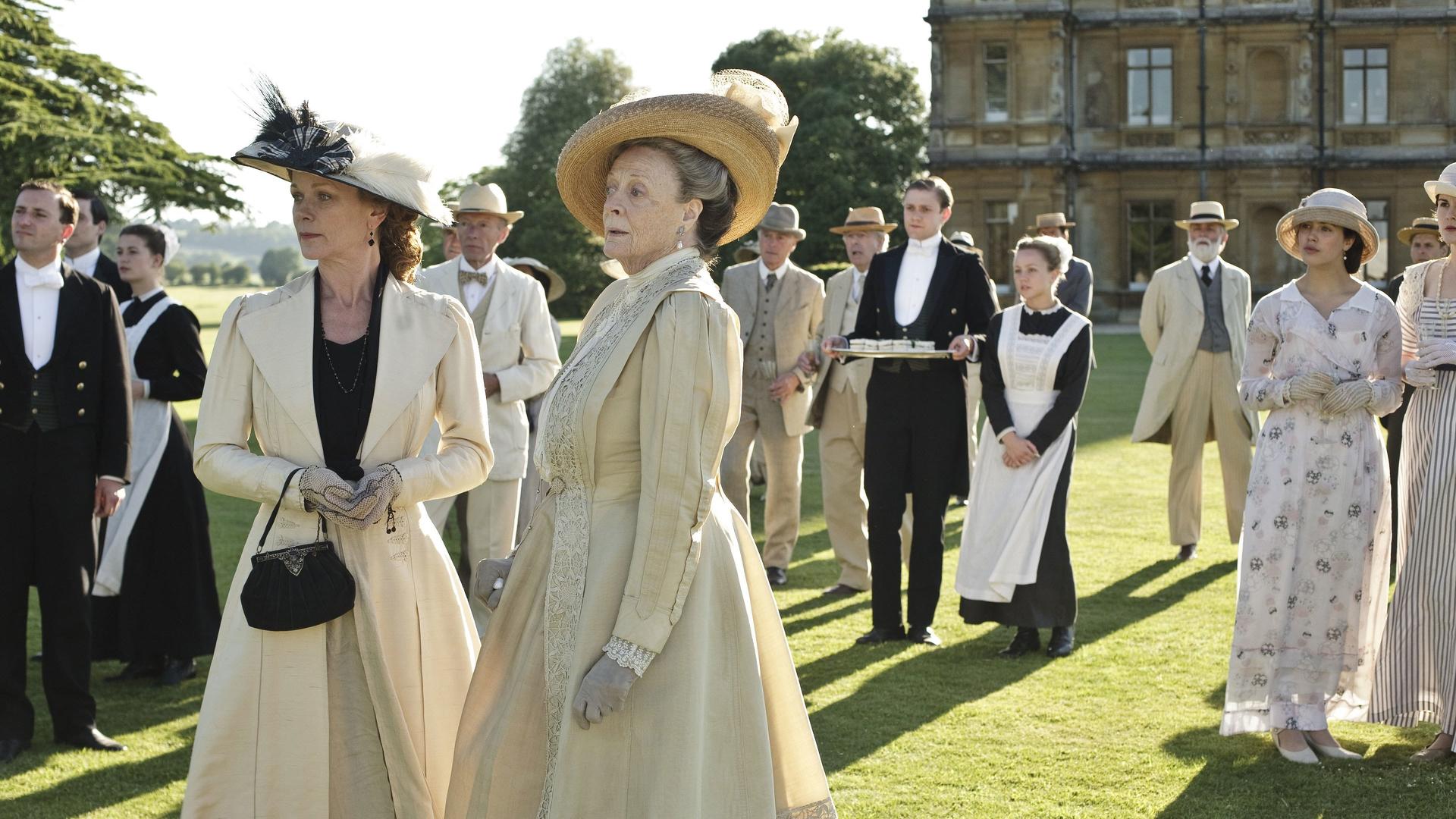
“Costumes can be read as easily as any text.”
— Leigh Summers
With the upcoming release of Downton Abbey: The Grand Finale on September 12th, audiences will return once more to the Crawley Family’s impressive home for the final chapter of a story that began in the shadow of the sinking of the Titanic and will close in the 1930s. Over the course of its six seasons and two films, Downton Abbey has spanned decades of seismic social and cultural transformation, from the Edwardian period through the devastation of the First World War, and into the glamour of the Roaring Twenties.
This article is the first in a two-part series exploring the costumes that shaped and reflected the Crawleys’ world — perhaps with a third to follow after the new film offers its concluding vision.

When was the Edwardian Era?
The Edwardian era was a period in the early 20th century, spanning the reign of King Edward VII from 1901 to 1910. It began with the death of Queen Victoria in January 1901, which brought the long Victorian era to a close. Although Edward VII’s reign itself was relatively short, the term “Edwardian era” is often used more broadly when discussing society, culture, and fashion. It may include the years leading up to the First World War, extending into the early reign of King George V. Some historians mark its end in 1914 with the outbreak of war, while others stretch it even further, describing the war years through 1918 as the final chapter of the Edwardian world.

Part of Downton Abbey’s enduring appeal lies not only in its layered drama of love and loss, but also in the sartorial vision that accompanies the various plots. The series’ costumes are as integral to its storytelling as its dialogue. Designed with historical accuracy yet tailored for modern viewers, they trace the shifting lines of a society in flux: from the structured elegance of the pre-war years to the practical necessities of wartime, and finally to the freer, looser fashions of the 1920s. In this sense, costume becomes a narrative device for character distinction and development.
This first article will turn its attention to Downton Abbey’s seasons 1 and 2, which span the years 1912 to 1919. By reading character through dress, we can see how the wardrobe choices reveal the characters’ inner workings and express identity. Fashion before the Great War, during it, and in its aftermath frames generational contrasts between the three Crawley sisters, their mother, and grandmother. Dress also distinguishes the upstairs from the downstairs world of Downton Abbey, even as war blurred some of these divides, and thus, the costumes illuminate both personal character and broader cultural change.

A Brief Edwardian Fashion History
Edwardian fashion marked a transitional moment in women’s dress, bridging the elaborate styles of the late Victorian period and the streamlined elegance of the early 20th century. While 1910s fashion initially retained features from the previous decade, it gradually moved toward simpler lines and a softer silhouette compared to the decade before, which was dominated by the so-called “S-curve.”
The S-shape of Early Edwardian Fashion
The early 1900s were dominated by the dramatic S-curve silhouette, a hallmark of Edwardian ladies’ fashion. This look was achieved through rigid corsetry that pushed the bust forward and the hips back, creating a “S” shape. The aim was to accentuate a small waist and a pronounced “mono-bosom”. This exaggerated form was further reinforced by loose blouses (see right image), which added volume to the upper half of the body. As seen in fashion plates from the early 1900s (see left image), this structured aesthetic defined the early phase of Edwardian female fashion.


A Shift towards Simplicity
By the 1910s, women’s fashion began to embrace a more natural, columnar silhouette. It saw the S-curve give way to straighter lines and a narrower shape. While the look was more relaxed, corsets were still a necessary foundation; though now redesigned to support a higher waist and a more vertical posture. These garments helped create the “pillar” look of 1910s women’s fashion, often complemented by narrower skirts that tapered at the hem. Echoing the neoclassical influence of a century earlier, many gowns of the time featured a softened empire waistline, nodding to early 19th-century styles, which themselves took inspiration from antiquity. This streamlined elegance defined much of the 1910s in Western fashion.

The Crawley Sisters
The Crawley sisters — Mary, Edith, and Sybil — are some of the most fascinating characters in Downton Abbey to study through costume. Each of their wardrobes reflects their inner lives, their personal journeys, and the changing world around them. From pre-war Edwardian fashion to the more practical styles during World War I and the beginnings of post-war modernity, their looks evolve alongside their circumstances.


Lady Mary Crawley
As the eldest daughter of Lord and Lady Grantham, Mary shoulders the responsibility of carrying on the Crawley legacy. This sense of duty is embedded in her style from the very beginning. Lady Mary’s dresses in Downton Abbey signal tradition, restraint, and poise — all qualities expected of an aristocratic eldest daughter in the 1910s.
Mary’s early wardrobe, designed by Susannah Buxton for the first season of Downton Abbey, was inspired by the wardrobe of Edwardian socialite Heather Firbank, who was described as “fashionable without being fussy.” That phrase captures Mary perfectly. Her dresses, often in darker jewel tones and slightly structured silhouettes, align with late Edwardian fashion. While never avant-garde, her looks are always elegant, refined, and entirely appropriate for her role. Large Edwardian hats adorned with feathers and ribbons also complete many of her early looks, a staple of women’s fashion before the war.


The Edwardian Woman’s Wardrobe — Hat Edition
Hats were an indispensable part of Edwardian fashion, and no respectable woman of the period would have left the house without one. In the early 1910s, wide-brimmed, flamboyant women’s hats were the dominant fashionable style, lavishly decorated with flowers, feathers, ribbons, and other ornate embellishments.


The early seasons of Downton Abbey reflect this trend, showcasing exquisite examples of these creations. Michelle Dockery, as Lady Mary, wears several variations of this signature style, perfectly capturing the elegance of 1910s fashion and the attention to detail in the show’s celebrated costume design.


Cora and Mary Crawley. Downton Abbey, Season 1.
Edwardian Fashion in Transition: Evening- and Daywear During WWI
The strict rules of Edwardian evening wear are on full display in Downton Abbey. When the dinner gong rings, the upstairs inhabitants exchange their afternoon or daytime attire for their most formal evening finery — even when dining alone as a family. Light cottons and simple fabrics are set aside in favour of sumptuous, elaborately beaded gowns, costly jewellery, headpieces, and tiaras. No woman of high society would appear in the evening without silk or kid gloves, which could be removed discreetly at the dinner table but had to be put back on before moving into the drawing room after dinner. These rituals are a hallmark of Edwardian fashion, signalling both status and propriety.


Cora, Mary, Edith, and Sybil Crawley. Downton Abbey, Season 1.
By Season 2, however, the series marks a decisive shift in style. Set in 1916, two years after the events of Season 1 and in the midst of the First World War, the tone of the Downton Abbey costumes becomes more restrained. Lady Mary’s and the other ladies’ evening gowns, while still elegant, are notably more subdued than in the early 1910s. Dresses are reworn with greater frequency, accessories are less ostentatious, and the dazzling feathers and jewellery of pre-war evenings give way to a more sombre aesthetic, muted in respect to the conflict in Europe.


One of Mary’s most striking gowns from this period is a black and blue lace tiered dress with velvet ribboned sleeves, assembled from vintage fabrics by the costume department. The lace tiers were taken from an original Edwardian gown and layered over a smoky blue chiffon base, creating a look that is understated yet still grand; it reflects both wartime austerity and her character’s growing maturity.

Importantly, the costume designers, with the addition of Rosalind Ebbutt in season 2 to capture Downton at war, paid careful attention to colour palettes and paired women’s gowns with the scarlet red of the men’s military uniforms. Thus creating a complimentary colour palette in group scenes.
In daytime settings, when the men are seen in khaki uniforms, the women’s clothing then provides the counterbalance: Lady Mary, for instance, appears in crimson when bidding farewell to Matthew at the train station, echoing as similar palette, but in reverse.


Just like the evening attire at Downton Abbey becomes slightly more muted, so daywear is equally subjected to change due to the impact of war encroaching on Downton. Practical skirt-and-blouse combinations become more common, with hemlines slightly raised compared to the floor-length silhouettes of the earlier seasons. There are fewer changes of attire throughout the day, underlining wartime austerity in civilian life — even among the aristocracy.
At the same time, the show cleverly contrasts rural and urban influences. Lavinia, a Londoner, dresses in a style that feels more fashion-forward, hinting at the approaching 1920s.
This scene from season 2 of Downton Abbey is a great example of that. The differences are very subtle, but we can see that Lavinia’s dress appears less structured with more of a flow to it; and her hemline is just a little bit shorter compared to Mary’s.


The differences are a lot less subtle in her evening look: The waist is barely accentuated, the ankle is on full display (🫢), the fabric loose and flowy, topping off the outfit with a headband, which definitely is more closely aligned with what we think of 1920s fashion.

Lady Mary and the Dawn of a New Age
Apart from a few exceptions, Lady Mary’s wardrobe in Downton Abbey is dominated by strong, jewel-toned colours such as deep burgundy, navy, or greens. According to The Costumes of Downton Abbey by Emma Marriott, these hues were deliberately chosen to reflect her resolute and determined nature, while also complementing her fair complexion. They also align her visually with her grandmother, Violet, the Dowager Countess, whose own wardrobe often features similar jewel tones. This subtle connection reinforces the frequent comparisons drawn between Mary and Violet, particularly in the later seasons, as it becomes increasingly clear that Mary is the one destined to carry the torch for the Crawleys and for Downton Abbey.
One striking example of this jewel-toned palette is her burgundy “proposal dress,” worn during the Crawleys’ New Year’s celebration marking the turn of the decade from 1919 to 1920.

This gown perfectly encapsulates the transitional moment between the final years of the 1910s and the dawn of a new era. Its raised hemline reveals a daring glimpse of ankle, foreshadowing the shorter hemlines that would soon define 1920s fashion, while its softer, less structured silhouette hints at the loose shapes of the coming decade. Yet, rooted in 1910s fashion, the gown still retains a natural (slightly raised) waistline and is made from a heavier silk taffeta fabric. In this way, it bridges the world of World War I fashion with the more liberated style that was about to emerge.
Country Pursuits
Mary’s wardrobe also reflects her identity as a country aristocrat, particularly in her hunting ensembles. Tweeds were essential for outdoor pursuits in upper-class wardrobes, and Mary is no exception. Throughout the series, she asserts her enjoyment of country life and hunting. Following the war, during her engagement to Sir Richard Carlisle, Mary appears in a tailored checked tweed walking suit that epitomises the transitional fashion of the late 1910s inching closer toward the 1920s. Again, inspired by socialite Heather Firbank, Mary’s version is more fitted, with a jacket and matching skirt. While the hemline is only subtly raised, the evolving silhouette is unmistakable with a straight cut and the illusion of a dropped waist with the application on the front of the jacket. Her hat, too, closely resembles the cloche styles that would dominate the next decade. This ensemble is a telling example of how the Downton Abbey costumes capture the gradual shift from Edwardian fashion into the modernity of the 1920s.


This ensemble not only illustrates the gradual stylistic shift from Edwardian fashion to 1920s glamour, but also symbolically mirrors Mary’s own position within the story. Like her wardrobe, she stands poised between eras — torn between tradition and change, between the security offered by Sir Richard and the emotional pull of Matthew.
Lady Edith Crawley
As the middle Crawley sister, Edith begins her journey in the series in the shadow of Mary and Sybil. Edith’s wardrobe is perhaps the clearest example of how costumes show character development in Downton Abbey. Her early looks are modest, verging on the old-fashioned, with her high-waisted Edwardian empire-line gowns with puffed sleeves emphasising her girlishness and insecurity. Where Mary’s dresses exude elegance, Edith’s seem plainer, more straightforward, reflecting her overlooked position.

Lady Edith’s Wartime Wardrobe
The impact of the First World War eventually reaches the home front, reshaping women’s everyday dress as vast numbers of women take on jobs once reserved for men, from agricultural labour to work in munitions factories. At Downton Abbey, this shift is most clearly reflected in Edith, who begins to step into roles outside the confines of her aristocratic family. Her wartime clothing becomes noticeably plainer and more functional, signalling both her growing independence and her usefulness in a society upended by war. For the first time, Edith dons practical garments such as work clothes and jodhpurs — items that would have been unthinkable for women, especially of her class, just a year or two earlier.


Edith Crawley. Downton Abbey, Season 2.
Although many rituals at Downton remain unchanged, wartime does relax some of the strict sartorial codes. The Downton Abbey costumes in Season 2 reflect these subtle shifts: fewer outfit changes occur throughout the day, daytime skirts become less constraining, and skirt-and-blouse combinations occasionally reveal a glimpse of ankle. Edith, in particular, embodies these transformations. As she learns to drive a tractor and takes up agricultural work on the Downton estate, her attire echoes that of the Women’s Land Army during WWI: breeches, jodhpurs, cardigans, working jackets, laced-up knee-high boots, and her hair tied back with a practical scarf. These outfits mark a striking departure from the rigid Edwardian fashion of the pre-war years, underscoring how the war disrupted the restrained, often monotonous lives of aristocratic women.


While her daytime attire grows more functional, Edith’s evening wear, like Mary’s, becomes more sombre in tone during the war years. In season 2 she appears in black satin, gowns with chiffon overlays, and dresses trimmed with understated metallic thread or lace. The lavish excesses of pre-war style that we’ve seen in season 1 on the likes of Lady Mary are notably absent, replaced by more subdued choices appropriate to a world at war. Nevertheless, the silhouette remains rooted in 1910s fashion, still drawing on the empire-line shape typical of the decade.

The result is a nuanced portrayal of Edith’s journey through season 2: her wardrobe mirrors both the broader societal changes of World War I fashion and her own evolution as a character, carving out an identity that is no longer solely defined by her title or her sisters.
However, Edith’s full transformation into a confident, independent woman is held back until the 1920s, when her style blossoms at last.
Lady Sybil Crawley
The youngest Crawley sister, Sybil, is portrayed as kind and compassionate, but also rebellious. From the start, her wardrobe signals her modern spirit and sets her apart from her sisters. In season 1, she famously shocks her family by appearing at dinner in a pair of two-toned light blue harem pants — an audacious example of Orientalist-inspired Edwardian fashion. For an aristocratic young woman in this period, such a choice would have been extraordinary. The outfit rejects both class-bound convention and rigid gender expectations, visually aligning Sybil with the growing calls for change.


Her harem pants go beyond a playful fashion experiment: they embody her youthful freshness, her preference for lighter colours, and her willingness to embrace modernity. They also visually reflect her sympathy with the suffragette cause, which was reaching its peak in the years just before the war.
“Orientalism” in Edwardian Fashion
One important stylistic development during this time was the influence of “Orientalism” on Edwardian era fashion, especially after the Ballets Russes’ 1910 Paris performance of Schéhérazade (based on One Thousand and One Nights). This ushered in a wave of “exoticised” aesthetics across 1910s women’s fashion, particularly through the work of Paul Poiret (French fashion designer and couturier), who popularised the columnar silhouette, rich textiles, and fluid draping.
While Rose’s “flying dress” doesn’t explicitly reference “Orientalist” fashion, it evokes a similarly romantic sensibility. The floral embroidery and the loose, flowing jacket-like top suggest a gentle nod to Japanese design reminiscent of the kimono. While not a direct replica, the look reflects the broader cultural influences shaping fashion in the 1910s, and offers a perfect example of how Edwardian female fashion interpreted global aesthetics through a Western lens.


Left: Fancy Dress Costume by Paul Poiret, 1911 (The Metropolitan Museum of Art).
Right: Denise Poiret at the 1002 night party held by Paul Poiret in 1911.
Note: The 1910s fashion trend “Orientalism,” drew inspiration from the “Orient” (referring to the Middle East, Asia, and North Africa), presenting it as exotic and alluring. When talking about these fashion influences today, we need to be aware of how problematic this is, as it often involved misrepresenting and simplifying diverse cultures, perpetuating stereotypes, and reinforcing Western perceptions of superiority.

The Impact of War on Sybil’s Costume and Character
From the very beginning, Sybil is established as a character who desires more from life than her aristocratic circumstances allow. Unlike her sisters, she refuses to idle away her days; she wants to be useful, to enact change, not only for herself but for those less fortunate around her. The outbreak of the First World War, while devastating, provides her with the opportunity to do something meaningful. With vast numbers of wounded soldiers returning from the front, nurses were urgently needed. Sybil trains with the Voluntary Aid Detachment (VAD), a programme that attracted many middle- and upper-class women. Since the work was unpaid, they could afford to give their time freely. Though some of their duties were lighter, such as bed-making, the job was nevertheless demanding and could include tending to men who had lost limbs or suffered other severe injuries.
Her nurse’s uniform quickly becomes one of her defining looks in season 2, embodying both her compassion and her rejection of aristocratic privilege. Historically, a VAD nurse’s uniform consisted of a blue dress with a white apron and a red cross armband. In the series, however, Sybil wears a grey dress instead of blue. Emma Marriott’s The Costumes of Downton Abbey notes that this was a deliberate design choice, though it does not explain the reasoning. Perhaps the grey was chosen for practical cinematic reasons that allows the nurses to blend into the sea of khaki and muted tones on screen rather than standing out too starkly. Yet, I wonder if there was also a deeper narrative intention: a visual cue to align Sybil more closely with the sombre world of war, or to symbolise her break from aristocratic brightness into the muted sacrifices of service.

WWI VAD Nurse’s Uniform. Source: Research Worcestershire.
After the war, Sybil continues to wear her older dresses rather than investing in new ones — a subtle costume detail that shows her refusal to return to pre-war aristocratic ideals. Her looser silhouettes anticipate 1920s fashion, but her real “costume of independence” is her choice of love. By running off with the family chauffeur, she cements her rejection of Downton life, her clothes becoming an afterthought as her character’s choices speak louder.
From Mary’s restrained Edwardian elegance to Edith’s tentative independence and Sybil’s outright rebellion, the Crawley sisters’ wardrobes are a masterclass in how Downton Abbey costumes reveal and develop character, and are an integral part of the show’s storytelling.
Cora Crawley, The Countess of Grantham
When we first meet Cora, her wardrobe places her firmly in the realm of Edwardian fashion. As the mother of three young women, she often carries over elements of the early Edwardian period: gowns with high lace collars, long skirts that brush the floor, and blouses with fitted bodices. Her silhouette is more structured and corseted than that of her daughters, who have already embraced the softer, columnar styles of 1910s fashion.


Cora Crawley, Countess of Grantham. Downton Abbey, Season 1.
This sartorial distinction makes sense both narratively and historically. While her daughters are at the forefront of modern change, Cora reflects the gradual pace at which women of her generation tended to adapt new styles, incorporating select fashionable details rather than overhauling their entire wardrobe. As the series progresses, we see her adapt, but always a step behind her daughters, maintaining a sense of elegance and maturity.
Signature elements of Cora’s pre-war wardrobe include layers of draped fabric that create a sense of fluidity, long tailored coats, and elegant high-necked blouses. These choices position her as the Countess of Grantham, visually anchored in tradition yet still evolving with the times.


Costuming Authority: Cora During the First World War
In the second season, the outbreak of war transforms both life at Downton and Cora’s role within it. As mistress of the house, she oversees its conversion into a convalescent home for wounded officers, a responsibility mirrored in her wardrobe. While her clothing remains refined, it becomes subtly more practical. She is often seen in skirt-and-blouse combinations that no longer feature the high-necked lace blouses of the previous season, reflecting how World War I fashion encouraged a loosening of sartorial codes.
One of the most striking details of her wartime style is her bicorne hat — a silhouette with an upturned brim that enjoyed brief popularity during the First World War. Traditionally worn by European and American military officers, the bicorne carried connotations of authority and command. Its appearance in Cora’s wardrobe is particularly apt, symbolising her elevated role at the helm of Downton’s transformation. Within the language of Downton Abbey costumes, this choice of hat visually aligns her with the military world while reinforcing her position of responsibility and quiet strength.


Violet, The Dowager Countess of Grantham
As the oldest woman in the Crawley family, Violet is consistently dressed in late-Victorian and early Edwardian fashion, reflecting fashionable styles from when she was younger (from the late 1890s through the early 1900s). Her wardrobe remains firmly anchored in this earlier era, with high necklines, floor-length skirts, and a distinctly structured, corsetted silhouette that recalls the S-curve figure popular in the early Edwardian period.


According to Emma Marriott in The Costumes of Downton Abbey, the adornments on Violet’s hats — often lavishly plumed with feathers — are not merely decorative, but serve to enhance or reflect her mood. These touches emphasise her theatrical presence and reinforce her status as the sharp-tongued matriarch of the Crawley family.
Susannah Buxton, the costume designer for season 1 and the architect of each character’s signature look, drew inspiration for Violet from prominent real-life figures of the Edwardian period, most notably Queen Alexandra and Queen Mary. The parallels with Queen Mary are especially striking: both share similarities in silhouette, hat choices, and even the characteristic cane or parasol that Violet often leans on.


The decision makes sense, as both queens were Violet’s contemporaries, and Queen Alexandra in particular was celebrated as a style icon of the early 1900s, as professed by Vogue Magazine and imitated by aristocratic ladies of the period.
Where Buxton deliberately deviates from historical precedent is in Violet’s colour palette. While soft pastels dominated Edwardian fashion, Violet is instead dressed in strong jewel tones, such as deep purples, greens, and blacks. This choice underlines her formidable and uncompromising character while visually setting her apart from her daughter-in-law Cora and her cousin Isobel Crawley. To me, these jewel tones feel particularly evocative of late-Victorian fashion, reinforcing the generational divide and marking Violet as a woman of an earlier era whose worldview often clashes with those of the younger Crawleys.


Another subtle but telling detail is the faint echo of late-Victorian leg-of-mutton sleeves in some of Violet’s gowns. Though far less exaggerated than their 1890s counterparts, this shape of sleeve evokes her stylistic roots in a bygone era. Within the language of Downton Abbey costumes, these stylistic choices situate Violet firmly in the past while making her presence on screen visually distinct.
Violet’s costuming thus demonstrates how Downton Abbey fashion serves both authenticity and storytelling. By drawing on real Edwardian inspirations while deliberately retaining late-Victorian touches, the costumes convey her identity as a matriarch whose values, like her wardrobe, remain rooted in tradition, even as the world around her moves rapidly into modernity.
Closing Thoughts on the Downton Abbey Costumes
The careful blending of genuine period pieces with meticulously reproduced fabrics and designs is a cornerstone of the believability of the series’ costumes. By sourcing original lace, embroidery, and vintage textiles, the costume designers root the ensembles in historical authenticity.
What further strengthens the realism of Downton Abbey fashion is the way the characters’ wardrobes are presented as lived-in. Rather than introducing a completely new outfit in every scene, we often see individual dresses, skirts, or accessories reappear throughout the series. This repetition reflects how clothing would have been worn in daily life and aligns with the narrative realities of the period. It also enhances characterisation: the items a character chooses to reuse, or how they combine them, convey their personality, status, and mood.


Cora and Mary Crawley in Downton Abbey, Season 2.
Moreover, the series occasionally offers glimpses of garments being handed down from the upstairs ladies to the downstairs staff, reinforcing the social hierarchies while adding a layer of continuity and intimacy to the storytelling.


These subtle details — the recycling of dresses, the careful layering of accessories, the interplay of colour and texture — allow the costumes to function as representation of this period in fashion history and narrative instruments. In this way, the sartorial choices in Downton Abbey not only bring the early twentieth century vividly to life but also deepen our understanding of the characters’ identities, relationships, and the broader social transformations that shape their world.
Want to continue the story and learn more about the Downton Abbey costumes?
Downton Abbey: A New Era of Fashioning Character Through Clothes
The world of Downton changes with the advent of the 1920s: hemlines rise, and silhouettes and protocols loosen. In Part Two, I explore how costume evolves from 1920 to 1929, tracing the Crawleys’ transition into a new decade of glitz and glamour.

Leave a Reply