
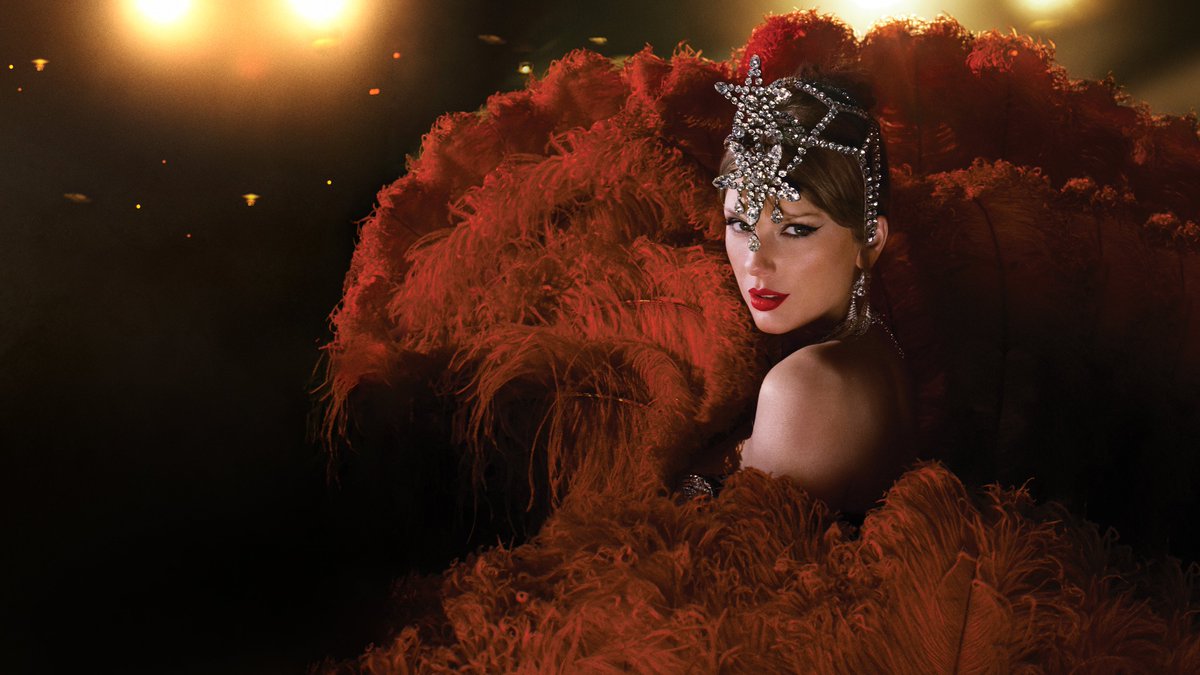
“Take the glory, give everything
— Taylor Swift “Clara Bow” (2024)
Promise to be dazzling.”
As Taylor Swift releases her 12th studio album, The Life of a Showgirl, it feels only fitting to look back at the glittering history of showgirl fashion. From the first Cancan dancers in their Moulin Rouge costumes of the 1890s, to the feathered glamour of the 1920s showgirl, to the dazzling rhinestones of Las Vegas and beyond, the showgirl has always stood at the intersection of fashion and performance.
At first glance, showgirl costumes seem designed purely for the male gaze: corsets, sequins, plumes, and not much else. Yet, when we trace Moulin Rouge fashion history, there’s a much more layered story to be discovered. Showgirl fashion has always been entangled with questions of agency and allure — simultaneously objectifying and empowering.
Think of Josephine Baker in her banana skirt in the 1920s, Marilyn Monroe shimmering on screen in the 1950s, or Britney Spears and Lady Gaga turning pop into performance art. Each embodied the “life of a showgirl” in their own way: Celebrated for their beauty, scrutinised for their private lives, and always balancing the dual roles of vulnerable ingénue and commanding vixen.
The archetype of the showgirl may have shifted over time, but the idea of her refuses to disappear. Who was the showgirl? And why is her image so enduring? While the traditional showgirl revealed her body beneath sequins and feathers, Taylor Swift has spent nearly two decades baring her inner life, thoughts, and feelings to her audience. With her latest release and the many visual images of her in dramatic showgirl get up, she writes the next chapter in showgirl fashion history.
Read on to explore showgirl fashion history, from its infancy in the cabarets of 1880s and 1890s Paris, through the glitz of the Jazz Age, the spectacle of mid-century Las Vegas, and finally to Taylor Swift’s modern reinvention of the showgirl.
Origins of the Showgirl
The term cabaret derives from the Picard French camberete, meaning “small room.” By the 1600s, cabaret in English referred to taverns or wooden dwellings for gambling and drinking, often frowned upon as places of ill repute well into the 18th century. But by the late 19th century, the cabaret had evolved into something far more sophisticated: A gathering place for artists, poets, and bohemians.
That transformation began in earnest with the opening of Le Chat Noir in Montmartre in 1881. Founded by the artist Rodolphe Salis, the venue started as an artistic salon that blended drinking, conversation, and variety acts into an irresistible formula that soon spread across the city. Inspired by this success, Joseph Oller and Charles Zidler opened their own cabaret in 1889 beneath a red windmill on the Boulevard de Clichy: The Moulin Rouge.


Inside, audiences were treated to a new form of spectacle. Daring female dancers lifted their skirts to perform the scandalous Cancan, flashing petticoats, stockings, and glimpses of intimate undergarments as they kicked their legs high into the air. These first 1890s showgirls and their costumes — corsets, frills, and extravagant feathers — created a visual shorthand for what we now think of as Moulin Rouge costumes, establishing an aesthetic that still defines showgirl fashion today.

By the early 20th century, the word showgirl itself had crossed the Atlantic. American theaters advertised their “celebrated chorus of stunning Showgirls gorgeously gowned,” as one 1902 poster put it. Historian Elspeth H. Brown notes that some of these women were less dancers than living mannequins, displaying costumiers’ creations on stage. In this way, showgirl costumes became an early form of runway, placing fashion before mass audiences while cloaked in the glamour of performance, and thus also attracting the female gaze.
Yet the world of the showgirl was fraught with contradictions. While some performers became celebrities, others were stigmatised for exposing their bodies on stage. The long-standing associations between theater, prostitution, and exploitation shadowed the profession. Wealthy patrons often expected sexual access to dancers, and abuse was rife. Sadly, such dynamics echo into the present, with the exploitation of female pop stars — from tabloid shaming to high-profile harassment cases, such as the one between Kesha and producer Dr. Luke — reminding us how persistent these power imbalances in showbusiness remain.
The definition of a showgirl has always been fluid. In the broadest terms, she was anyone hired to appear in a revue, but depending on the performance, she might be called a burlesque dancer, a stripteaseuse, or even a fan dancer. What unites these identities is the costume: the feathers, sequins, sparkling bodysuits, and towering headdresses that made the showgirl both an object of fantasy and an icon of style. As fashion historian Jane Merrill put it, “the costume is the message of fantasy, and the wearer is the show.”
These showgirl costumes crystallised by around 1910. By the 1920s showgirl era, revues showcased an array of outfits — from shimmering flapper-inspired looks to exotic fantasy costumes — catering to audiences that ranged from working-class voyeurs to middle-class theatergoers in search of escapism. The costumes always reflected the fashions of their day, but in exaggerated, theatrical form. In the Belle Époque, waists were cinched and curves accentuated; by the Jazz Age, silhouettes were slimmer and more athletic, echoing the fashionable flapper figure.
Though her role has changed across decades, the showgirl remains a cultural constant: a performer whose costume of feathers, sequins, and sparkle communicates allure and spectacle. From the red windmill of the Moulin Rouge to the rhinestoned stages of Las Vegas, and now to the pop concerts of our own time, the life of a showgirl continues to shape the story of fashion, performance, and femininity.
The 1890s Showgirl: Moulin Rouge Costumes
When we conjure the image of the showgirl, feathers, sequins, glittering lights, and bare legs immediately spring to mind. This enduring vision of women in dazzling costumes, high-kicking across the stage was first crystallised in Belle Époque Paris. Between the 1880s and the early 20th century, the cabaret culture of Montmartre gave birth to the modern showgirl costume, one that both reflected and exaggerated contemporary fashion. It was at the Moulin Rouge that performers like La Goulue and Jane Avril became icons, their wardrobes forever tied to the mythology of the Parisienne and to the idea of the showgirl as a cultural symbol.
Cabaret, Music-Halls, and the Birth of the Showgirl
Montmartre in the mid-19th century was a heady mix of poverty, artistic bohemia, and libertine nightlife. By the 1880s, it had become the center of the city’s cabaret and café-concert culture, offering both Parisians and tourists an escape from bourgeois respectability.
Cabarets like Le Chat Noir had pioneered the idea of intimate artistic gatherings, but with the founding of the Moulin Rouge in 1889, the formula expanded into grand theatrical spectacle. The venue’s famous red windmill quickly became synonymous with excess, sensuality, and the French Cancan — a dance that shocked and delighted audiences with its high kicks, twirling skirts, and unabashed display of petticoats and stockings.

At the same time, the Folies Bergère and other music-halls developed a new type of revue, where women’s bodies became central to the entertainment. These were not ballerinas of the opera, whose elegance signaled refinement, but dancers whose cheeky humor, risqué moves, and costumes provoked both fascination and scandal.
As historian Laurence Senelick has shown, risqué female attire predated the music-halls, with women from brothels infiltrating chorus lines as early as the 1860s. By the 1890s, however, such performers had become professional “dancing girls,” and their costumes cemented the visual codes of showgirl fashion history.

The Early Showgirl Look: Corsets, Petticoats, and Feathers
The silhouette of 1890s showgirl costume mirrored that of mainstream Belle Époque fashion, but in exaggerated, theatrical form.
- Corsets cinched the waist tightly, creating an hourglass figure designed to dazzle under the gaslights and, later, electric bulbs of the stage.
- Petticoats were layered to create volume that dancers could manipulate with every kick, and could be made up of up to sixty yards of lace and other fabric.
- Stockings, often black silk to stand out against white frills, sometimes revealed inches of bare thigh with each lifted leg.
- Feathers and hats added vertical drama, further emphasising the spectacle of a revue performance.
- Colors were bold and vibrant: cherry red, emerald green, sky blue, and yellow satin bodices delighted the eye in a swirl of gaiety.


Examples of dancers from ca. 1880 to the early 1900s. Sources: Pinterest.
The costumes pushed the boundaries of what is acceptable (on stage only!) by shortening skirts to reveal legs, something unacceptable in everyday “street wear.” La Goulue (the stage name Louise Weber was known by) said about her show costume:
“One must have pretty knickers. They’re indispensable. Without nice knickers, no Cancan. Me, I prefer white knickers, long petticoats with fine lace, and pantaloons furnished with lots of ruffles. It is possible to wear colored knickers, but they should be pale. Tights must be black, the better to stand out against the white. When you’re dressed like this you can raise your legs without any worry. I must nonetheless add that I never dance without first attaching the bottom edge of my pantaloons to my stockings with pins. Women who show their flesh, that’s disgusting.”

Her account illustrates how showgirl costumes may have defied the conventions of regular fashion, yet the performers still adhered to their own standards of propriety.
Showgirls and the Fashion Industry
The connection between showgirl fashion and the wider fashion industry is apparent. Some music-hall dancers were employed as fashion models, using the stage to parade their costumes before audiences. Designers and costumiers recognised the stage as a powerful advertisement for couture.
Showgirls thus appealed not only to the male gaze but increasingly to the female gaze as well. Women in the audience might covet a sequined bodice or feathered hat. In this way, the Moulin Rouge fashion history intertwines with the broader narrative of Paris as the global fashion capital.
Glamour and Exploitation
For all their allure, showgirls occupied an ambivalent social position. While some became celebrities, others faced stigma for displaying their bodies. Longstanding ties between theater and prostitution meant that dancers were often vulnerable to exploitation by directors, patrons, and audiences alike. Calls of “higher, show it!” greeted many Cancan performers, and rumours of backstage coercion were common.
Yet, for many women, the stage offered opportunities unavailable elsewhere: steady wages, a chance at upward mobility, and the possibility of celebrity. Compared to drudgery as a seamstress or modiste, becoming a showgirl could indeed be an aspirational path. As historian Mel Gordon observed, to be on stage was not shameful in Paris; it was a preferable alternative to poverty or prostitution.
Evolution of the Cancan Costume
Much like everyday fashions, the Cancan costume itself wasn’t static and constantly evolved, even while retaining central elements. Early versions emphasised layers of lace-trimmed pantaloons and petticoats, but over time, skirts shortened and the display became increasingly teasing.
Nicknames like “Skin like Satin” or “Pretty Thighed Nini” reflected how body parts became commodified, turning dancers into anonymous elements of a line-up. Yet, despite criticisms, the Cancan, perceived as a symbol of French sexuality by the rest of the Western world, was exported across Europe and the United States, where it influenced both burlesque and saloon culture.
From Petticoats to Plumes: Lasting Legacies
By 1910, the showgirl costume had stabilised into a recognisable formula: corset, stockings, petticoats, feathers, and sparkle. These elements, born in Belle Époque Montmartre, would endure through the Jazz Age, Las Vegas spectaculars, and even the stages of contemporary pop stars.
The spectacle of the 1890s showgirl was not simply about nudity or scandal; it was about artifice and performance, a carefully constructed image of glamour. The legacy of the Moulin Rouge is one of entertainment and fashion history alike. The feathers and sequins of Montmartre live on in haute couture collections, in the rhinestones of Las Vegas shows, and in the dramatic stage costumes of today’s performers, such as Taylor Swift, Lady Gaga, Sabrina Carpenter, etc.


The 1920s Showgirl
The First World War left Paris longing for escape, and the city’s music halls delivered. Out of that cultural hunger emerged the revue à grand spectacle: a dazzling production that elevated the showgirl from playful cabaret dancer into a full-fledged icon of glamour. In contrast to the 1890s showgirl at the Moulin Rouge, whose costumes were frilly, risqué extensions of everyday Belle Époque dress, the 1920s showgirl was born in a world of precision choreography, cinematic competition, and a hunger for spectacle that reshaped entertainment.
From Belle Époque to Jazz Age Glamour
At the turn of the century, Parisian courtesans embodied the ideal of beauty of the era: corseted, bosomy, and swathed in elaborate silks. By the 1920s, however, the athletic female body was celebrated. Cycling, tennis, and boating sculpted a new ideal, which was echoed on stage in the slim 1920s showgirl. Shorter skirts revealed long legs clad in silk stockings, sometimes layered two or three deep for sheen.


Jeanne Florentine Bourgeois known on stage as Mistinguett (1920s).
This shift mirrored broader fashion history. Daywear slimmed into the streamlined flapper silhouette, with dropped waists and boyish bobs. On stage, the same look was exaggerated into sequined bodysuits, beaded bandeaux, and skirts cut daringly high (if worn at all).
Precision and the Rise of Costume Design
Unlike the improvised cabarets of the 19th century, post-war music-hall revues were meticulously planned. Directors sketched out themes and teams of costumiers translated them into hand-sewn costumes. A single production could demand over a thousand unique looks, requiring battalions of dressmakers and artisans. At Max Weldy’s atelier, hundreds of seamstresses applied rhinestones, sequins, feathers, and roses by hand, creating costumes that shimmered under the spotlight.
These weren’t mere garments, but feats of engineering. Costumiers balanced fantasy with durability, ensuring outfits could survive vigorous routines, including high kicks and acrobatics.


The spectacle was immense. Revue girls paraded down staircases in coordinated lines, sequins flashing under stage lights, and feathers fanning — the writer Peter Leslie called this the “age of superlatives.”
The influence of Art Deco filtered through costume design: sleek silhouettes, geometric motifs, and stylized “exoticism.” Audiences thrilled at tableaux ranging from Roman chariot races to Egyptian fantasies (which was particularly popular fuelled by archaeological findings of Ancient Egypt in the 1920s), Paris landmarks, and fairy-tale heroines.


Russian Dancers in Egyptian Inspired Costumes (1920s.) Source: Pinterest.
Josephine Baker
No figure embodies the contradictions of the 1920s showgirl better than Josephine Baker. Bursting onto the Paris stage in the mid-1920s, she shocked and delighted audiences. Her infamous banana skirt, devised with her friend Jean Cocteau, is still very recognisable today.

Josephine’s performances were steeped in exoticism, race, and spectacle. She used motifs of her African heritage with jungle settings, and tapped into colonial stereotypes and the stage tradition of “the noble savage.” Her performances, thus, with their complex racial undertones, both celebrated Black culture, but still engaged with the European fetishisation of Black women.
She herself has stated that her racially charged performances are a powerful tool for her to challenge and resist racial prejudice, and she used her stardom to fight against segregation, authoring several articles, openly refusing to perform for segregated audiences, and speaking alongside Martin Luther King Jr. at the March on Washington. Scholar Alicja Sowinska argues, her stage persona became a means of mutual exploitation. Her own memoir Fearless and Free has been published, translated into English for the first time in early 2025, and will hopefully shed more light on her own views and thoughts regarding her performances.
Baker’s costumes ranged from macramé and feather ensembles to jagged-hemline flapper dresses, accessorised with Deco jewelry. She became muse to couturier Paul Poiret, later inspiring Patrick Kelly and Marc Jacobs. Beyond the stage, she understood the power of self-branding: She advised women on how to make moisturisers from bananas in order to fight wrinkles, and advertised Le Bakerfix, a pomade to slick down hair, which brought her more revenue than all the other endeavors. Today, it’s become common for female popstars to branch out and start their own beauty lines — could it all be traced back to Josephine’s own self-marketing in the mid-1920s? However, it wasn’t just Josephine herself, who made revenue off her own brand, other enterprises were quick to jump on the opportunity: Dolls dressed in banana skirts were sold across Europe by the thousands, and stickers publicising her movie, Zou Zou, were distributed among fruit vendors in Paris to be placed on bananas they sold. Similarly, today, brands are quick to jump on the bandwagon whenever Taylor Swift releases music, using their social media to join in the meme culture, such as Lidl’s “Life of a Bakery Girl (Lidl’s Version).”

Josephine Baker went on to open her own nightclubs in Paris and New York, really emphasising that the stage, with all its exploitative elements, also meant opportunity.
The Relationship between the Revue Stage and Couture Houses
The intertwinement of couture and revue deepened in the 1920s. Designers like Lucile created for the Ziegfeld Follies, while Jean Patou dressed the Dolly Sisters both onstage and off. In turn, the sisters’ Paris outings became media events, their costumes and couture wardrobes blurring the line between performance and lifestyle.

This exchange was symbiotic: Couturiers gained publicity through the dazzling showcase of their designs, while revues burnished their reputation with the cachet of high fashion. The stage became a living runway. And unlike street fashion, showgirl costumes reveled in audacity: Bikini-esque ensembles and rhinestoned bodysuits that would only decades later filter into mainstream dress.
The 1920s were the height of music-hall success, with no fewer than 77 revues staged in Paris. Productions transported audiences through rapid-fire scenes from Tivoli Gardens to Roman chariot races, each demanding elaborate new costumes. The ambition rivaled cinema, which often borrowed from revue aesthetics in films.
This appetite spread beyond Paris, with troupes like the Tiller Girls touring internationally, exporting their shows and glittering costumes to London and New York. The 1920s showgirl crystallised the image we still associate the most with the term today: Feathers, sequins, and elaborate headdresses, worn by women who dazzled as much through performance as through costume. Though each era reshaped the archetype, the Jazz Age perfected its formula, ensuring that from the Moulin Rouge costumes of Paris to the pop concerts of the 21st century, the showgirl remains an enduring icon of spectacle, style, and seduction.
The Mid-20th Century Showgirl
1920s showgirl fashion had crystallised the image of feathers, rhinestones, and bare legs; the postwar decades magnified it into an international symbol of glamour. After World War II, Paris reasserted itself as the capital of chic with the opening of the Lido de Paris in 1946. Its productions dazzled with jewel-like sparkle and statuesque dancers. The Lido exported not just its shows but its costumes, its aesthetic, and eventually its performers across the Atlantic. By the 1950s, the showgirl was increasingly tied not only to the Paris stage but to the casinos of Las Vegas.
From Paris to Las Vegas: A New Stage for Glamour
Las Vegas was still a fledgling city when showgirls arrived in the 1940s and 1950s, chasing opportunity along the expanding Las Vegas Strip. The first modern casino, El Rancho Vegas, debuted its “El Rancho Starlets” — a chorus line of scantily clad dancers who embodied the city’s promise of entertainment and freedom. By the mid-1950s, major casinos invested in Parisian imports: Lido de Paris at the Stardust, Casino de Paris at the Dunes, and Folies Bergère at the Tropicana.

The contrast was immediate. Parisian revues emphasised elegance and glamour; Vegas translated this into speed, polish, and scale. The spectacle of showgirls processing across vast stages in towering plumes became synonymous with the city itself, and the showgirl look had solidified into the image still recognisable today: rhinestones, sequins, nude illusion bodysuits (and sometimes not illusion), and impossibly tall feathered headdresses. Guest curator of costume and textiles at the Nevada State Museum Karan Feder has described showgirl costumes as engineering feats as they had to endure the often intense choreography on stage. Rhinestone chains in Tiffany-style mounts draped and moved with the dancer’s body. Pasties evolved from cardboard and buckram discs to glitter applied directly with glue. Rubber breastplates were introduced to appease censors before toplessness was legalised in 1959. Each costume was audacious, while always balancing on the line between covering and uncovering.
Lights, camera, bitch smile, even when you wanna die
Makeup and expression became an extension of the costume itself, with dancers painting their own faces before going on stage, drawing on exaggerated lashes (crafted paper lashes before falsies became widely available to purchase), bold liner, and red lipstick. Equally important was the smile. The Vegas showgirl smile, described as a “polished advertisement — frozen in eagerness” was considered a further extension of the sequined and plumed costume.


Much of the credit for the Vegas spectacular goes to Donn Arden, who brought Parisian shows to the American desert and added a distinctly American flair. He insisted on couture-quality costumes, including custom shoes, and Parisian jewelry. To Arden, strip tease was bawdy; his shows aimed for “class,” mixing topless dancers with lavishly dressed ones.
Costume designers transformed these visions into material excess. Pete Menefee recalled the sheer scale of Arden’s productions: staircases, fireworks, even the sinking of the Titanic; all requiring costumes that dazzled from a distance yet endured nightly wear. When Jubilee! opened in 1980, Bob Mackie’s jewel-toned finale costumes used so many Swarovski crystals that they caused a global shortage. Each dancer might change costumes eight to twelve times in a ninety-minute show, their bodies draped in feathers, chandelier crystals, and rhinestones.


The Vegas Showgirl (1950s). Source: Pinterest.
Paris remained entwined in this aesthetic. Even as productions like Folies Bergère became fully produced in Vegas, couture houses such as Dior contributed costumes in the 1980s and 1990s. Arden’s sets included Parisian street scenes and fireworks over the Eiffel Tower, cementing the French cachet as central to Las Vegas glamour.
Hollywood and the Pop-Culture Showgirl
While Vegas cemented the live spectacular, Hollywood carried the showgirl into global popular culture. With the advent of the film musical in the 1930s, the revue’s spectacle was translated to the silver screen. As Linda Mizejewski observes in her book Ziegfeld Girl, cinema both displaced the showgirl and immortalised her.

By the 1950s, the archetypal Hollywood showgirl was a streamlined version of her Parisian ancestor, clad in sequined corsets, fishnets, and bowler hats. Gentlemen Prefer Blondes (1953) dressed Marilyn Monroe and Jane Russell in glittering bustiers and gloves, sometimes topped with fedoras or feather headdresses.

Later, designers like Bob Mackie carried the look into pop culture, dressing Cher in feathered headdresses and rhinestoned bodysuits. Today, Mackie’s designs resurface in the wardrobes of stars like Sabrina Carpenter, while Jean Paul Gaultier, Marc Jacobs, and Prada continue to borrow from the vocabulary of Moulin Rouge costumes and Las Vegas revue glamour.

For half a century, Las Vegas sold itself through the image of the showgirl, emphasising the Parisian connection, and audiences came expecting sequins, feathers, and spectacle. Productions evolved year by year, from Versailles fantasies to tableaux of Rosie the Riveter and suffragettes, but the formula remained constant: Beautiful bodies, lavish costumes, and audacious scale.
The Folies Bergère ran at the Tropicana for nearly fifty years, while Jubilee! held the Strip for 34 years before closing in 2016 — the last of the great showgirl revues. Along the way, feathers became prohibitively expensive (the bird flu of the 2000s doubled import costs), sequins gave way to synthetic fabrics, and tastes shifted. Yet the Parisian cachet never disappeared: when the Paris Hotel opened in 1999, fireworks erupted over its Eiffel Tower, echoing the staged spectacles Arden had pioneered decades earlier.
From the Moulin Rouge costumes of the 1890s to the streamlined glamour of the 1920s showgirl, the mid-century spectacle distilled a century of showgirl fashion into its most enduring form. Even now, when the revues have faded, the archetype endures on screen and in our imagination, decked out in rhinestones, feathers, and smiling under impossible headwear.
Promise to be Dazzling: Taylor Swift and The Life of a Showgirl
From the 1890s cabarets of Paris to the glittering stages of Las Vegas, the showgirl has long been a symbol of spectacle, glamour, and meticulously choreographed performance. Though the classic showgirl revue has become increasingly rare, the spirit of the showgirl lives on in contemporary pop culture. Today, the archetype has evolved: Performers are no longer always part of a uniform chorus line but the central focal point of a carefully crafted spectacle. In many ways, the modern pop concert functions as a living showgirl revue — complete with elaborate choreography, dazzling outfits, and often theatrical storytelling.
The Contemporary Showgirl
Traditionally, the showgirl costume emphasised the ensemble rather than the individual, turning performers into a uniform ideal. Today, however, the emphasis has shifted. Pop stars like Taylor Swift, Beyoncé, Lady Gaga, and others are the focal point, with dancers acting as background performers. The showgirl’s legacy remains, however, visible in film and live theater alike, for example Showgirls (1995) and the very recent The Last Showgirl (2024). These performers continue to captivate audiences with over-the-top style, glamorous moves, and stunning costumes, ensuring that the essence of the showgirl endures.

As traditional Las Vegas revues become increasingly rare — the last true spectacle, Jubilee!, closed in 2016, and only four venues remain in Paris — the term “showgirl” has broadened to encompass modern pop stars. These performers are typically the main attraction, performing alone rather than as part of a uniform line. Contemporary concerts function as full-scale spectacles, combining choreography, costume changes to carry forward the traditions of showgirl fashion and performance.
Today’s pop stars reinterpret the showgirl legacy in a variety of ways. Dita Von Teese embodies the closest vision of the classic showgirl, performing in rhinestones, feathers, and elaborate headdresses across multiple themed tableaus; she even collaborated with Taylor Swift on the Bejeweled music video, teaching her one of her signature acts. Lady Gaga consistently brings theatrical drama to the stage through her costumes and set designs, while Britney Spears represents a different, darker facet of the showgirl: a performer pushed to her limits, whose body and image have been scrutinised and exploited by the people around her and the media. Meanwhile, Sabrina Carpenter embraces mid-century aesthetics and playful double entendres, and Chappell Roan, often hailed as Gen Z’s Lady Gaga, creates a campy stage persona that evokes the hyper-theatricality of the classic showgirl.


Promise to be Dazzling: Taylor Swift
The Eras Tour was not the beginning of Taylor Swift’s showgirl-ism — her career has been marked by theatrical world tours, from the stagecraft of Speak Now to dramatic performances in the pouring rain, both real and artificial, and onstage costume changes. On this record-breaking latest tour, her beaded bodysuits, choreographed performances, and dramatic stage sets combine to create a full-scale showgirl spectacle.


The Eras Tour
With the glittering costumes of The Eras Tour, Taylor Swift fully cemented her showgirl image. The beaded bodysuits, the sheer spectacle of the stage, a “sexy chair dance choreography” referencing Cabaret (1972) and Chicago (2002), and the off-stage drama of breakups, dalliances, and budding romance all played into the mythology. Each “era,” each act of the concert, unfolded like a new tableau in a classic showgirl revue.

One set in particular underscored this connection: The Tortured Poets Department, which was added to the setlist halfway through the tour during the international shows. The closing number of this segment turned out to be an Easter egg, foreshadowing what was to come. After her “death” on stage, Taylor is “reanimated” by her dancers, transformed in an onstage costume change into what is essentially a showgirl costume, or at least the whisper of one. When she turns back to face the audience, she snaps instantly into performance mode, the dazzling smile firmly in place. It is a moment that recalls Liza Minnelli in the 1972 film Cabaret, singing “Life is a Cabaret” with a bright smile even as she seems to be holding back tears — the mask of the performer fixed on despite the cracks beneath.


The staging only heightens the effect. Visuals evoke 1920s theatrical revues, while her female dancers — dressed in uniform ensembles that play with male tailoring — mirror Swift’s own costume. Accessories like feather fans and canes complete the scene, clearly gesturing toward the world of the showgirl. Reflected in the song I Can Do It With a Broken Heart, is the showgirl ethos: The performer must pull herself together, get on stage, and smile, even when her personal world is unraveling.
The Life of a Showgirl
The showgirl costume really came into focus in Paris in the 1920s within lavish productions at such venues as the Folies Bergère and the Casino de Paris. The iconic look — the briefest of adornments, often in silver fabric and sparkling rhinestones, elaborated with extravagant plumage — eventually defined itself, and froze in time.
It’s precisely this image of the showgirl that is echoed in the visual material surrounding Taylor Swift’s forthcoming album, The Life of a Showgirl. Across the campaign, she borrows from a century of showgirl costumes and iconography, reinterpreting them for a contemporary audience. Let’s have a look:

The most traditional take comes with her Baby, That’s Show Business vinyl cover, which is also the first of her (alternative) album covers not to feature her alone. Instead, she appears as part of a line-up, posed beneath theatrical stage lighting. Here, she leans fully into classic showgirl fashion: Jeweled bras and slips, rhinestones catching the light, towering feather headdresses, and feathered accessories. The near-identical costumes emphasise the uniformity of the group, recalling the precision and glamour of choreographed dance numbers.
Other images isolate Swift in this same classic look, reframing the showgirl not as one among many, but as the singular star — a fitting reflection of how the pop showgirl diverges from her 20th-century predecessors.


Of course, the queen of Easter eggs and references layers in nods to other touchstones of showgirl fashion history. One sequence recalls Velma Kelly in Chicago (2002), with Taylor adopting the sharp black bob and sultry chair choreography that itself referenced Bob Fosse’s 1972 Cabaret.


Another image leans even more directly into Cabaret, evoking Liza Minnelli’s stripped-down, Berlin-style showgirl. The dominance of black and red tones underscores this connection, setting it apart from the rhinestoned extravagance of Las Vegas-style productions.


Perhaps the most contemporary vision of a showgirl emerges in the advert for the Target-exclusive vinyl. Here, the look is polished to a high-gloss finish: A dusty pink peplum corset, soft curls, luminous skin, and muted makeup (punctuated only by a red lip). The corset itself comes from The Blonds’ Fall/Winter 2023 Valley of the Blonds collection, a camp and exaggerated homage to Old Hollywood glamour inspired by Jacqueline Susann’s novel Valley of the Dolls.


The Blondes’ collection pulled references from its namesake, exploring the highs and lows of stardom — a theme which from everything we know so far and keeping the history of the showgirl in mind, will probably be the central theme of The Life of a Showgirl.
Even in this updated guise, classic references remain. The look is crowned with a custom Bob Mackie headdress, an unmistakable nod to showgirl costumes of the past. Worn in different iterations by Dita von Teese, it reinforces the continuity of this visual tradition, linking Swift’s modern take on The Life of a Showgirl to a long legacy of spectacle, glamour, and performance.

Final Curtain Call: Closing Thoughts
In her illustrated history of showgirl costumes Jane Merrill argues that showgirls have always understood that they were performing as sexual objects, lightly clad in rhinestoned, sequined, and feathered costumes. Yet there is a certain complexity about the showgirl’s stage presence, always balancing sexual appeal with classy demureness, tackiness and kitsch with wonderful campness, vulgarity with sophistication — always reconciling opposites in dazzling equilibrium.
As a result, today as well as in the showgirl’s early days, she is revered and beguiled, transforming into a fashion icon and a celebrity. In spite of this, the early showgirls of the 1890s and 1920s, were never truly accepted into the upper echelons of high society. This offers another, yet more figurative, comparison we can make between Taylor Swift and the showgirls of a bygone era: At this level of stardom, Swift seems at once accessible and impossibly distant. She can be admired, even idolised, but she remains untouchable — removed from those around her, no matter whether they be admiring fans or famous and wealthy peers.
As a carefully calibrated balance of near-nakedness and acceptability, the showgirl’s undress transformed eroticism into spectacle. Of course there was a sensual dimension; the women chosen were selected for their physiques, which they displayed with confidence. Yet it was never purely salacious. Stylisation rendered it both sexy and chaste. Showgirls were not simply erotic entertainment for male audiences but integral to a larger, multi-faceted spectacle that held appeal across genders.
This is perhaps the most difficult aspect to map onto Taylor Swift. Nakedness and salaciousness are not typically associated with her artistry. That said, when the first visuals for The Life of a Showgirl were released, many observers noted that they had never seen her in such a state of undress. This is not entirely true — similar looks appeared in the Bejeweled music video or on the red carpet at VMAs in 2022 — but it has never been presented as overtly as it is in this album cycle. Even so, her imagery, like the showgirl’s, is highly stylised, never salacious. Swift has never been an artist who caters to the male gaze, which influences how these images are received.


From another angle, we might argue that she has always laid herself bare before her audience — not in a physical sense, but a figurative one. For nearly two decades, she has offered her thoughts, feelings, heartbreaks, and inner life to her listeners, making vulnerability itself her most enduring form of undress.
Costuming as Liberation
Showgirl fashion has always reflected cultural ideals of femininity, but it has also allowed women to claim space on their own terms. The tension between objectification and agency runs throughout showgirl fashion history: Women used the stage to entertain, but also to earn financial independence and celebrity. Costumes were both uniform and armor, creating a stage persona that elevated the dancer beyond ordinary constraints.

From the 1890s Cancan dancer to the 1920s showgirl, and from Moulin Rouge costumes to the rhinestone-bedecked revues of Las Vegas, showgirl fashion has balanced spectacle, eroticism, and empowerment. With The Life of a Showgirl, Taylor Swift taps into this rich visual history, hinting at what the album might be about: Offering a glimpse of life as a glamorous pop star on stadium tours, while also hinting at the challenges behind the scenes — navigating setbacks like having her art sold away or facing public scrutiny and getting Cancelled! — and how she transforms them into her own advantage (or, by the time this is uploaded and we’ve actually listened to the album, it all might be utter BS, but such is The Life of a Swiftie).

Leave a Reply