
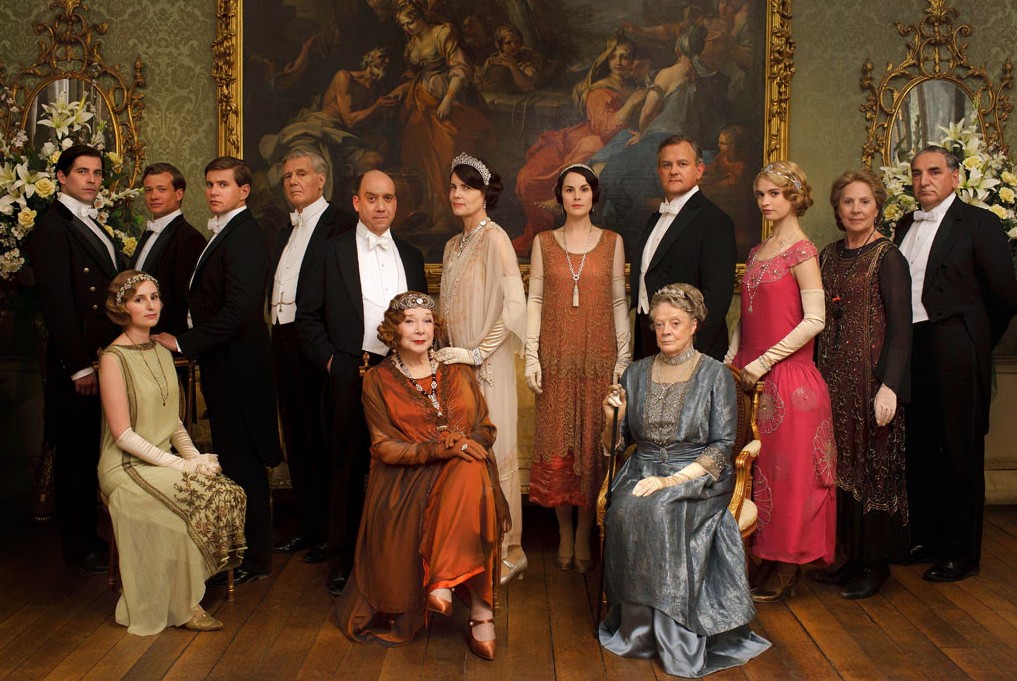
With the release of Downton Abbey: The Grand Finale in theaters, audiences can once again step into the Crawley family’s world. The series, which began in the shadow of the sinking of the Titanic and chronicled the seismic shifts of the First World War, has always been attentive to the ways social change and character development are mirrored in dress: from the structured silhouettes of the late Edwardian period, wartime fashions and the post-war wardrobe, to the Roaring Twenties.
This is the second article in my two-part series and examines the costumes that define Downton Abbey in the jazz age, taking a closer look at 1920s fashion. Perhaps, there will be a third part to follow after the new film offers its concluding vision 👀
Missed the first part of this article series?
Downton Abbey: A Study in Character and Clothing,
where I traced the Crawleys’ wardrobes through the late Edwardian period, the First World War, and its aftermath from 1912 to 1919, examining how costume reflects character development, social change, and the evolving world of Downton.


A Brief 1920s Fashion History
While the 1920s are typically remembered in popular culture as an era of glitz and glamour with a strong focus on evening wear, the decade also marked one of the most significant turning points in women’s fashion history.
The end of the First World War, only a year before the new decade began, had a profound impact on society, culture, and fashion. Women’s wardrobes shifted towards a new simplicity, offering greater convenience for the modern woman. Layers of formality that had defined previous decades and centuries gave way to clothing that reflected independence and practicality.
Hemlines On The Rise
During and after the war, hemlines had already begun a slow climb, with a hint of ankle occasionally revealed. In the new decade, this change was accelerated with skirts reaching their shortest length around the knee in 1927 just before they began their slow descent once again.


from Stewart & Company (ca. 1925). Source: The Metropolitan Museum of Art.

Flapper Fashion: “La Garçonne”
The Flapper — or “La Garçonne” — came to define much of 1920s fashion. Characterised by androgynous lines and dropped waists, it offered a radical departure from the structured silhouettes of preceding decades. Just as hemlines rose, waistlines followed the opposite path, dropping lower until 1923, holding steady for several years, and then beginning to rise again in 1928.


This new silhouette, with its simple lines and boxy, almost boyish shape, looked best on figures without pronounced curves. It is often assumed that women abandoned corsets altogether, but in reality, shaping undergarments were still widely worn. Their purpose, however, had changed: rather than sculpting curves, they now flattened the body to achieve the fashionable straight-line silhouette.
Hair was also an essential part of this modern, ‘tomboyish’ look. Many women cut their hair into a bob or pinned it up to create the illusion of shorter styles. The most popular cut was the shingled bob: short at the nape of the neck with a distinctive tapered “V” shape, lengthening gradually toward the front.

Even bolder was the sleek, close-cropped ‘Eton crop’, parted deeply to one side and named after the English boys’ college Eton.

No ensemble, when leaving the house, was complete without a hat. While a range of styles was available, the cloche hat became the defining accessory of 1920s fashion. Its snug fit and rounded silhouette perfectly complemented the decade’s short hairstyles.


The Continuation of the Distinct Styles of Cora and Sybil
Though Sybil appears only briefly in season 3 before her tragic death, just on the cusp of the new decade, the few glimpses we get still carry the spirit of her earlier Downton Abbey costumes. When she returns to Downton after her marriage to former chauffeur Tom Branson, Sybil’s rebellious streak is on full display: she is the first of the three Crawley sisters to cut her hair short, embracing the cropped styles that were becoming emblematic of 1920s fashion.

There is also a distinctly bohemian feel to her ensembles. One standout is a grey velvet, flowy dress adorned with arts and crafts-inspired embroidery at the hem and cuffs. The floral and nature motifs echo the movement’s aesthetics and its promotion of looser, more comfortable clothing. Compared to her sisters’ wardrobes on screen, Sybil’s pieces come closest to the relaxed silhouettes that would soon dominate the decade.

Cora, Countess of Grantham, remains consistent in her sartorial choices as well, her signature aesthetic, while evolving with the times, retains its essence. The draped layers and flowing fabrics she favoured in earlier seasons carry seamlessly into the 1920s, aligning beautifully with the era’s looser silhouettes. A terracotta silk coat, for example, features a long scarf that attaches at the back and wraps elegantly around her neck.


Another striking example is an original 1920s evening dress she wears in season 6, with airy chiffon layers that create a rippling effect with her movements — a hallmark of her style since season 1.


Several of her grand evening gowns also carry this sense of fluidity: for the ball in the first feature film and the lavish party in the South of France in the second movie, she wears gowns with sheer, draped chiffon sleeves that fall from her shoulders to the floor, encapsulating the soft, ethereal side of her Downton Abbey costumes.


When the Old World Meets the New: A Transatlantic Fashion Clash
Cora’s mother, Martha Levinson, enters the world of Downton Abbey with dramatic flair, sporting fur-trimmed coats, plumed hats, and an air of confident exuberance. She embodies the striking figure of a wealthy American woman who has fully embraced the changes of the new decade, her wardrobe showcasing the bold lines, rich textures, and confident energy that modern viewers instantly recognise as hallmarks of 1920s fashion. Among the Downton Abbey costumes, hers stand out as unapologetically modern and fashion-forward.


Martha is often shown side by side with Violet Crawley, the Dowager Countess, and their appearances together underline just how much the world has changed. While Violet clings to her Edwardian silhouettes with the structured tailoring and high-necked lace blouses of a bygone age, Martha embraces the dawn of the Jazz Age, wearing ensembles far more daring than even the younger generation at Downton. On screen, they are presented as polar opposites: Violet representing the traditions of Europe’s old world, and Martha embodying the progressive spirit of America’s new world. Their visual contrast is striking, as though two different decades — or even centuries — are seated beside one another, their attire as different as their opposing views.
Kindred Opposites: Violet and Isobel Crawley
Another pairing described as a double act in The Costumes of Downton Abbey by Emma Marriott are Violet and Isobel Crawley. Though they also hold opposing views of the world and the rapid social progress around them, their relationship evolves into a genuine and touching friendship over the course of the series and the two feature films. This gradual shift is also mirrored in their sartorial choices.
While Violet remains loyal to her Edwardian silhouettes, Isobel adopts subtle touches of 1920s fashion. Yet Violet’s own style does not remain static: although her silhouettes stay rooted in the Edwardian era, her colour palette transforms quite dramatically. When we first meet her, her wardrobe is dominated by dark jewel tones, underscoring both her formidable character and a hint of lingering late-Victorian influence (as discussed in part one of my Downton Abbey costume analysis). As the 1920s progress, these darker hues give way to softer mauves, lilacs, pale blues, and creams; tones far closer to Isobel’s colour palette. When they appear together, they are often dressed in complementary shades.


This softening of Violet’s colours also carries symbolic weight. According to the costume companion, Violet, who represents Downton’s past, is gradually fading. This symbolism becomes especially clear when she is placed alongside Mary. In one particularly telling moment, Mary is dressed in high-contrast silver with black embroidery, a striking visual signal of her role in leading Downton into the future, while Violet appears beside her in a very pale blue gown with silver embellishment, described as “almost ghostly.”

Flapper Flair Arrives at Downton: Lady Rose MacClare
As the 1920s progress, Downton Abbey fashion begins to embrace more of the typical sartorial hallmarks of the 1920s, and Rose MacClare quickly becomes the embodiment of this modern spirit. One of the most striking accessories of the decade that dominates both the screen and the period’s style is the cloche — a close-fitting, bell-shaped hat, usually worn low over the forehead to complement the cropped hairstyles so fashionable at the time.


From left to right: Edith Crawley, Rose MacClare, Cora Crawley, and Mary Crawley (Downton Abbey, Seasons 4 – 6).
Evening wear at Downton, while still highly formal and often accompanied by long opera gloves, evolves to mirror the changing silhouettes of 1920s fashion. The gowns become looser, with raised hemlines, dropped waists, and flowing fabrics such as soft silks and chiffons. These 1920s evening dresses are richly adorned with embroidery, beadwork, sequins, tassels, and fringed edges, often styled with jewelled headpieces. As the Jazz Age reaches its peak in the mid- to late-1920s, an array of glossy layered silks and shimmering details twirl across the screen, offering a feast for the eyes.


Left to right: Mary Crawley, Rose MacClare, Edith Crawley, Cora Crawley (Downton Abbey, Series 4 – 6 and Downton Abbey: A New Era).
There is also a marked difference between the ladies’ evening wardrobes at Downton and their looks when in the city. Rose is the clearest example of this “double life”: while her daytime and Downton ensembles often appear youthful and demure despite their playfulness, she transforms into the image of flapper fashion when she sneaks off to London nightclubs, donning slinky, sparkling dresses made for dancing the night away.


Over the course of the final seasons, Rose matures from spirited party girl to sophisticated young woman. Yet her wardrobe never loses its sense of energy, with her evening dresses always giving the impression that she’s ready to swirl and swish around in them. Many follow the typical mid-1920s silhouette with a slightly more fitted bodice until the hips, then flares out towards the bottom, often in delicate pastel pinks or powdery blues and embellished with floral embroidery and beadwork.


Rose MacClare, Downton Abbey (Season 4 – 6).
A Debutante for a New Decade
As a young aristocratic woman, Rose undergoes the traditional ritual of being presented at court — her formal debut to society. This ceremony, which had been paused during the First World War, resumed in the early 1920s and typically included a series of debutante balls and parties designed to introduce young women to eligible bachelors.
Traditionally, debutantes wore white gowns, though by the early 1920s light pastel shades were also acceptable. The ensemble required a train attached at the shoulders, white gloves, and either a fan or a small bouquet, topped off with a headdress of white tulle and ostrich feathers.

Rose’s debutante gown is especially striking because it follows the silhouette of the briefly popular robe de style — a dropped-waist gown with a fitted bodice and a full skirt supported by hip panniers, creating a romantic bell shape. This design nods to the 18th century while infusing it with 1920s flair. Described as fun-loving, wild, and free-spirited, Rose wears this romantic silhouette beautifully, its pale pink hue and youthful shape capturing her character’s lively essence.


A Look Below Stairs
While change swept through the upstairs world of Downton Abbey fashion, the transformation below stairs progressed at a much slower pace. There was a common sentiment at the time that employees were often more conservative than their employers, hesitant to embrace changing trends. Limited financial means also made it harder to adopt new styles, and the work patterns of domestic service simply made fashionable dress less necessary and feasible. While the upstairs ladies dazzled in the latest 1920s fashion, change below stairs largely resisted such rapid shifts.
Visually, the Downton Abbey costumes of the servants are far less colourful than those of the inhabitants upstairs. Characters like Mrs Hughes, Anna, Daisy, and Mrs Patmore spend long days working from early morning until late at night, and are almost always dressed in some variation of a uniform.
In the earlier seasons, the housemaids wear two distinct uniforms: a daytime uniform in sage green with a white apron and cap, following a typical late-Edwardian silhouette, and a black uniform of the same shape with a white headpiece and slightly more ornate white aprons featuring lace appliqués. The housemaids appear much more uniform compared to Mrs Hughes, the housekeeper, whose black dresses are more individualised. As the years progress, change happens very slowly below stairs, but with the turn of the decade, the silhouettes of the uniforms loosen slightly, and hemlines rise just a little.


Subtle shifts also occur off duty. Cloche hats begin to appear on staff members during their free time, though they are far plainer than the ornate and decorated versions worn upstairs. The staff are usually shown wearing the same cloche hat with various outfits, which lends a sense of realism to the Downton Abbey costumes.


The Personal Sartorial Journeys of the Women Downstairs
We can particularly trace change in Anna’s wardrobe as she is promoted from housemaid to personal lady’s maid. She continues to wear black, but her uniform loses the apron and cap, gaining more individuality. Her look becomes closer to Mrs Hughes’ black dresses, though Mrs Hughes’ clothing is differentiated through richer fabrics, subtle embroidery, and lace that add texture. Mrs Hughes’ style stays much closer to the Edwardian period, while Anna slowly embraces elements of 1920s fashion.


By the time of the first Downton Abbey feature film, Anna’s off-duty look has evolved into a full 1920s ensemble — complete with the fashionable cloche hat.
A particularly interesting downstairs pair to observe are Mrs Patmore and Daisy. Mrs Patmore’s ensemble remains essentially unchanged throughout all six seasons and the two films: a printed cotton blouse and long skirt, a linen apron, and a cotton cap, with only the colours and patterns varying.


Daisy, on the other hand, undergoes a lengthy transformation. She begins as a kitchen maid, often seen in two or three different ankle-length, high-waisted dresses paired with a simple cotton apron tied at the waist.


When promoted to assistant cook in seasons 3 and 4, she dons a more formal kitchen uniform reminiscent of Mrs Patmore’s: a long-sleeved cotton dress in a faded colour with a subtle pattern, a linen apron with a bib front, and a cap, essentially turning into a miniature version of her mentor.
By the final season and the films, Daisy’s on- and off-duty outfits adopt the looser, dropped-waist silhouettes of the mid-1920s, and she sports a fashionable short bob hairstyle.

As we’ve seen, change below stairs at Downton Abbey moved at a far slower pace than it did upstairs. This was due in large part to their limited financial means: clothing and fabric were expensive, and a servant’s salary could not cover an extensive wardrobe. Their garments were made to last for years, often reworn and carefully repaired rather than replaced, marking a sharp contrast to the fast-changing world of flapper fashion and modernity unfolding around them.
Mary and Edith: A Game of Cat and Mouse
In the grand tapestry of Downton Abbey fashion, few threads are as captivating as the ongoing sartorial “rivalry” between Mary and Edith. Throughout the series, one is often slightly ahead of the other in fashionable matters, depending on where their character arc stands.
Mary leads the race at first. When she returns from her honeymoon with Matthew in season 3, she debuts a striking chiffon gown with a handkerchief hemline that falls in petal-like points — a design directly inspired by the couturière Madeleine Vionnet and the height of fashion in 1920. While Mary basks in the glow of newlywed happiness, Edith still lingers in her role as the overlooked younger sister, who was jilted at the altar.

But when tragedy strikes and Mary becomes a young widow, the balance shifts. Edith begins spending more time in London, mingling with artists and writers, and carving out a career as a columnist. This new independence propels her fashion sense far beyond what the quiet countryside of Downton could allow, and we see her experiment with different styles.


Edith’s Transformation
Edith’s true transformation crystallises in season 4, with what Emma Marriott dubs the “Criterion Dress” in The Costumes of Downton Abbey.


Edith Crawley, Downton Abbey (Season 4).
While her family is still cloaked in black mourning attire at Downton, Edith steps out in London for dinner with Michael Gregson at the Criterion in Piccadilly wearing a dazzling long turquoise beaded gown. The contrast between Downton and London has never been more pronounced: this dress, far more revealing and colourful than anything she could have worn at home, signals her break from the “ugly duckling” narrative imposed on her during earlier seasons. The gown’s design was inspired by the French artist George Barbier ‘s 1922 illustration “Sortilèges Evening Dress De Beer” with its bodice crafted from authentic period fabric.

Shortly after, she appears in a similar but slightly more modest halter-neck dress in peach-pink — still bold and beaded, but less provocative than the turquoise. Styled with waved 1920s hair, a bejewelled headband, and drop earrings, she exudes modern glamour. Once Edith steps into this new world, there is no going back.


Edith Crawley, Downton Abbey (Season 4).
Meanwhile, Mary is still in the shadows of mourning, but once she emerges, she quickly catches up. As she takes on more responsibility in running Downton, her wardrobe adopts more tailored details. One pivotal moment comes when she attends a London fashion show with her aunt Rosamund, wearing one of my personal favourite Downton Abbey costumes: a tailored daytime look made from contemporary blue silk with a dropped-waist belt, colour-contrasting pleated ivory silk collar and cuffs, and topped with a striking red cloche hat.


A Man’s World
As Mary becomes increasingly involved in the management of the Downton estate, her style embodies a distinctly modern spirit. She develops her own version of the three-piece suit, drawing directly from the male wardrobe: double-breasted suit jackets, collared blouses, ties, waistcoats, and structured coats. This mirrors a wider trend in 1920s fashion, when women embraced more androgynous lines and accessories.


Mary Crawley, Downton Abbey (ca. Seasons 5 – 6) and Downton Abbey: The Movie & A New Era).
Mary is also the first of the two to cut her hair short into the fashionable shingled bob. Her colour palette shifts toward bold primary colours and colour-blocking — reds, blues, and greens — brighter than her earlier jewel tones and symbolic of her renewed appetite for life. She doesn’t abandon her love of rich, dark hues, which still feature in her evening wear, but her daytime looks become fresher and more dynamic.


Mary Crawley, Downton Abbey (Season 5 – 6).
Mariano Fortuny’s “Delphos” Gown
Fortuny’s famous “Delphos” gown, like most of his designs, was inspired by Ancient Greek dress, because the unrestricted ancient style worked well with the fashionable loose 1920s silhouette. The “Delphos” gown in particular took inspiration from the ancient Greek chiton — a basic, sleeveless tunic made from a rectangle of fabric, typically linen or light wool, and fastened at the shoulders with pins or buttons. The “Delphos”, created from hand-pleated silk, was first constructed in 1907 by Fortuny’s wife.


For Downton Abbey: The Movie, a bespoke deep Prussian blue “Delphos” gown was created in collaboration with the Fortuny fashion house for Mary. In season 6, she even wears an original Fortuny “Peplos” gown (a two-layered version of the “Delphos”). This continuity reinforces a key trait of Downton Abbey costumes: Characters often return to signature silhouettes and designers, building a sense of wardrobe authenticity and personal style.


Mary’s style tends toward bold, graphic patterns, while Edith’s leans softer with delicate florals and feminine hues. In Downton Abbey: A New Era, Mary dazzles in an asymmetrical black and silver gown with a sparkling starburst motif, nodding to Hollywood glamour while staying true to her aesthetic.
Around the time when Mary regains her appetite for life and her sleek flapper fashion and elegant loose silhouettes underscore her growing authority at Downton, Edith’s story turns darker as she mourns the disappearance, and eventual confirmed death, of her lover Michael Gregson.
From Downton to London: Fashioning Edith as a Working Woman
Michael’s loss also propels Edith forward. He leaves her in charge of his magazine, and she reinvents herself as a working, modern woman in the city. We see her in a number of chic work ensembles, often incorporating feminine versions of masculine elements: pinafore dresses layered like waistcoats, ruffled neckwear echoing ties, and tailored jackets or capes.


Edith Crawley, Downton Abbey (Season 6).
Mary’s take on “workwear” is more overtly androgynous, while Edith retains a delicate, romantic edge even in professional dress. This contrast highlights the individuality of the Downton Abbey costumes: both sisters engage with the masculine trends of the decade, yet each bends them to reflect her personality.
By season 6, as Edith prepares to marry Bertie Pelham, the future Marquess of Hexham, her wardrobe slightly shifts again, reflecting her elevated status. She appears in what is purported to be an original Jean Patou (French fashion designer) gown: a champagne-coloured silk dress with micro-sequin embroidery, combining delicacy with luxurious lustre.


Holidaying on the French Riviera
In Downton Abbey: A New Era, Edith revisits elements of her style seen in earlier seasons. While she had once worn trousers during the First World War for practical reasons, they were never part of her everyday wardrobe. But on holiday at the French Riviera, she dons wide-legged palazzo pants — a quintessential look for the artistic set who frequented the region in the 1920s. This relaxed setting, far from both Downton and Brancaster Castle, lets Edith embrace bold, bohemian style.
She pairs the trousers with a headscarf, reinforcing the laid-back holiday feel. This accessory also recalls her earlier days as a modern London writer attending soirées at Michael Gregson’s flat with other artists, suggesting that while Edith has transformed into a Marchioness, her free-spirited creative streak endures.


Closing Thoughts on 1920s Fashion in Downton Abbey
The evolution of the Downton Abbey costumes across the 1920s perfectly illustrates that changes in fashion never occurred overnight, and neither did they happen uniformly across society. While modern viewers often picture the Roaring Twenties as a sudden explosion of short hemlines, flapper dresses, and cast-off corsets, history tells a more gradual story. Hemlines crept upward over several years, and loosening silhouettes emerged slowly after the First World War, shaped as much by social class, personal taste, and financial means as by the dictates of the fashion houses. The ladies of Downton Abbey exemplify this gradual progression, as do the women downstairs, whose conservative uniforms and slower adoption of 1920s fashion reflect both their practical lives and limited financial means.


Downton Abbey’s wardrobe masterfully balances historical accuracy with character storytelling. From Sybil’s bohemian dresses to Cora’s flowing chiffon gowns and Rose’s playful flapper ensembles to Mary and Edith’s individual interpretations of 1920s fashion, the costumes demonstrate how clothing conveys identity, social position, and personal evolution. Even subtle choices, like Violet’s softening colour palette in contrast to Mary’s bold 1920s hues, signal larger shifts in generational perspectives and societal change. These thoughtful design decisions highlight why the series is so celebrated for its attention to 1920s fashion history.
The Downton Abbey costumes remind us that the clock didn’t strike midnight on January 1st, 1920 and fashion trends were turned on their heads — change arrived in stages, often mediated by circumstance, environment, and personality.

Leave a Reply