
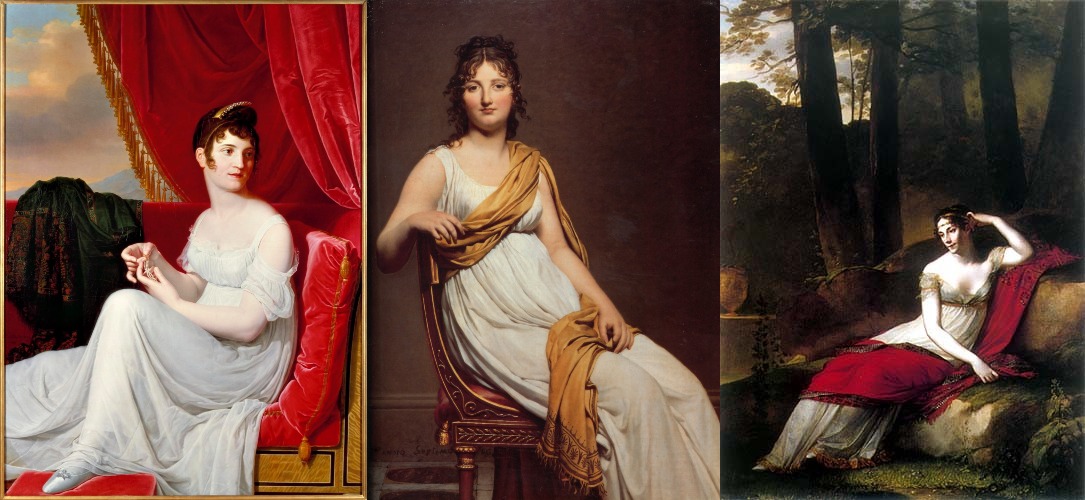
The first decade of the 19th century saw a dramatic transformation in European fashion. The voluminous skirts shaped by side hoops (panniers) and ornate trimmings that dominated most of the 18th century gave way to the high-waisted, columnar gowns of the Empire silhouette.
Inspired by the draped garments of ancient Greece and Rome, this neoclassical dress style of the post–French Revolution era imitated the clothing of ancient democracies, and was perhaps evidence of a new political philosophy on the rise.
This article will be the first in a series of “decade deep dives”, each of which will explore one decade in fashion history in detail. We’ll kick off with the early years of the 19th century, covering the years 1800 to 1809/10, and explore the decade’s defining silhouette, fabrics, accessories, and hairstyles, and the contrasts between French and British court dress.
The focus here will be on European fashions (primarily French and British) because this is the cultural sphere I grew up in and the area I’ve researched most deeply in academia. That said, this is not meant to disregard the richness of fashion history beyond a Eurocentric lens; rather, I don’t yet feel educated enough to write about it in the same detail.
If you scroll to the bottom of the page, you’ll find a list of sources used in this article, as well as a selection from my TBR list on Asian, African, and Latin American fashion history.

What is Regency Era Fashion?
Strictly speaking, the Regency era in Britain lasted from 1811 to 1820, when George IV governed as Prince Regent during his father George III’s illness. In fashion history, however, the “Regency style” reaches beyond those dates, and may include the years from the mid-1790s onwards that gave way to the rise of high-waisted gowns and classical influences, and may stretch until the late-1830s, covering the final decades of the Georgian period all the way to the dawn of the Victorian era.

Regency Fashion: The Neoclassical Silhouette Shift
The opening years of the 19th century brought about one of the most dramatic transformations in women’s fashion throughout fashion history. In a single generation, dress had moved from the wide panniers, conical stays, and richly decorated silks of the eighteenth century to the light, high-waisted gowns of the neoclassical style. The French Revolution accelerated trends already emerging in the 1780s, when garments such as the chemise dress, worn by influential figures like Marie Antoinette and Georgiana, Duchess of Devonshire, began to challenge the structured opulence of earlier decades.

The Chemise Dress or La Chemise à la Reine
In Louise Élisabeth Vigée Le Brun’s 1783 portrait, Marie Antoinette appears in a loose white muslin gown, tied at the waist with a yellow sash and finished with soft frills and puffed sleeves. This robe en chemise caused an uproar at the Salon of 1783, where it was swiftly withdrawn. Critics condemned it because it resembled an undergarment rather than the regal attire expected of a queen. Yet, scandal soon turned into a fashion trend. Also known as the chemise à la reine, the gown became the defining fashion of the late eighteenth century. It resembled the simple linen chemise (traditionally, the first layer of women’s dress) but featured a gathered waistline and flowing skirt, accessorised with a colored sash, and often a fichu (triangular shaped piece of cloth) over the bosom. Unpatterned and unadorned, its appeal lay in its airy lightness. Though its silhouette gradually narrowed and its waistline rose, the chemise dress remained fashionable well into the Napoleonic era.

Though the chemise evolved in shape, by the turn of the century, its simplicity and use of muslin had paved the way for the new Empire style. By 1800, the Empire silhouette was firmly established in Western fashion: dresses were cut with a high waistline directly under the bust, falling in a long, vertical line to the floor. Lightweight fabrics, particularly white muslin, dominated, reflecting the neoclassical preference for clean geometry that was also visible in contemporary art, architecture, and interior design. Skirts lost much of their rounded volume, falling to the ground in a columnar shape.


Innovative Dress Construction in Regency Period Fashion
Unlike the two-piece ensembles common in the 17th and 18th centuries, late Georgian fashion saw the rise of the complete gown. Specifically, the ‘apron-front’, ‘drop-front’, ‘placket-front’, or ‘stomacher-front’ gown began to emerge during the final decade of the 18th century. But, what are they? Well, they’re actually different terms for the same type of dress construction.


This design featured a bodice front attached to the skirt, which was cut with a flap; once the wearer had fastened the inner bodice lining, the skirt flap was tied around the waist and the bodice front was pinned into place. From ca. 1804 onwards, some dresses began to fasten with buttons up the centre back (referred to as ‘frocks’), but the drop-front dress remained a popular style up until around the mid-1810s.
A constant across these styles was the skirt length: women’s legs always remained covered. Even in the classical world, from which the empire silhouette took much of its inspiration, women’s garments were long enough to conceal the legs entirely. Though, in the neoclassical era, the hem might allow a glimpse of a ribboned sandal or slipper, but nothing more.

1800s Women’s Fashion: Necklines
How much skin a dress revealed depended on the time of day, the occasion or social situation, and the wearer’s status. A general rule to go by when analysing fashion, is that from the 17th century through the early 20th century, the bust and shoulders would be covered before the hour of dinner.
The increasingly codified etiquette of the 19th century demanded specific dress for a growing range of social situations from morning calls and carriage rides to theatre visits and evening balls. While late Georgian dresses often featured low necklines both in day and evening wear, women used tuckers or chemisettes to add modesty and warmth when needed.


Both these garments performed the same or similar function; to cover the exposed décolleté. A tucker was a flat piece of fabric like a small shawl or scarf, sometimes triangular in shape, intended to fill in the neckline of a low-cut gown.
A chemisette was more like a half blouse with side fastenings, and might have a collar. It provided more coverage than a tucker, including the chest, shoulders, and back depending on the cut of the gown it was worn with.
We can still find them today, but rather than chemisette, we’d look for ‘false collars’ or ‘fake collars’. Their primary function has also changed, rather than for modesty reasons, we might opt for these false collars to create the illusion of wearing a blouse underneath a jumper and avoid the discomfort of actually layering several items on top of each other.

Regency Era Fashion: Women’s Head Dress
Throughout much of Western fashion history, women’s headwear was closely linked to modesty and marital status. From the 15th through the 19th centuries, girls typically wore their hair loose until they reached marriageable age, at which point it was pinned up and often concealed beneath a cap. Indoors, these caps were commonplace, and when venturing outside they were usually covered by a bonnet. The tradition of covering women’s heads — today often associated with Islamic culture — was in fact just as deeply rooted in European custom.

In the early-1800s, hats and bonnets formed a striking contrast to the otherwise simple, columnar gowns of the Empire silhouette. While dresses were pared-down, millinery exploded with colour, texture, and variety. Ostrich feathers, silk ribbons, lace, flowers, and sometimes even fruit transformed headwear into statement pieces, with a range of available styles.
Straw hats enjoyed wide popularity during the decade and were a staple available in different shapes and forms, from wide-brimmed varieties to bonnets with upturned brims, and decorated with ribbons or floral trims.


Turbans were another fashionable option, particularly for evening dress. Worn in both full and half forms, they could be made of silk, muslin, or richly colored velvet, and were often adorned with feathers or jeweled ornaments.
Caps, by contrast, were softer and more domestic in character. Usually made from all kinds of soft material, such as cotton, muslin, lace, or silk, they wrapped neatly around the hair and could be decorated with ribbons, lace trims, or floral decorations.

To summarise, women’s headwear in the early-19th century was anything but uniform. Where dress silhouettes tended toward simplicity, hats and bonnets offered endless opportunities for expression, creativity, and ornamentation.

Neoclassical Dress: Inspiration from Antiquity
The neoclassical silhouette was part of a wider cultural fascination with the ancient world, fuelled by the mid-18th century excavations at Pompeii and Herculaneum. Fashion, like architecture and the decorative arts, looked to ancient Greece and Rome for inspiration. Women adopted draped shawls, Romanesque hairstyles, and jewellery with classical motifs. The dominance of white muslin was due in part to the mistaken belief that classical garments were uniformly white, an assumption based on the weathered marble of ancient statuary.

Central to the neoclassical ideal was the beauty of the natural body. The suggestion of nudity was conveyed through fine, clinging fabrics and revealing cuts. Low backs and wide necklines were common in evening wear (often only covered during the day by a thin layer of lace, muslin, or cambric) with the translucent quality of muslin allowing to trace the outline of the leg beneath.


The influence of classical antiquity extended beyond dress silhouettes to encompass jewellery and hairstyles. Women of the late-Georgian era generally wore jewellery sparingly, favouring delicate pieces such as fine necklaces, cameos, pearls, and hair ornaments adorned with classical motifs.

Hairstyles, too, underwent a dramatic transformation at the close of the 18th century. The towering, powdered constructions gave way to smaller, more natural styles inspired by ancient Greek and Roman art. Chignons, braids, and softly arranged curls became the blueprint, often accented with jewelled combs or ribbons. Short curls worn à la Titus inspired by Roman busts framed the face, completing the neoclassical effect.

The Politics of Simplicity
The neoclassical silhouette of regency period fashion goes beyond being an aesthetic preference, but can be interpreted as a visual response to the political upheavals of the late-18th century. The French Revolution began the dismantling of previously rigid and immovable hierarchies and, with them, the elaborate fashions that had symbolised aristocratic privilege. Hoops, panniers, and ornate brocades gave way to simpler, columnar gowns inspired by the clothing of ancient democracies, signalling a new cultural alignment with the new political philosophy of ideals of equality, civic virtue, and reason.
In France, this shift took root during the Directoire (1795–1799) and Consulate (1799–1804) periods, before reaching its peak under the Empire after Napoleon’s coronation in 1804.

While the cut of these gowns suggested simplicity, the reality was more nuanced: wealth was still visible in the quality of fabrics, the richness of embroidery, and the imported luxury of accessories. The visual simplicity of the muslin gown might evoke democratic ideals, but its wearer could still proclaim social status through fine Indian textiles, hand-painted patterns, and costly jewellery.
Keen to re-establish France as the centre of fashion and craftsmanship, Napoleon banned the import of English textiles, revived the Valenciennes lace industry, so that fine fabrics like tulle and batiste could be produced domestically, and even dictated court etiquette: women were forbidden to wear the same gown more than once at court, and long trains once again became a mark of formality in evening dress.
Inspiration from all over the world
Although classical antiquity remained the dominant influence, the politics and warfare of the Napoleonic era introduced a broader range of stylistic inspirations. Napoleon’s military campaigns carried not only troops but also cultural exchange, bringing foreign motifs into fashionable dress. His occupation of Egypt (1798–1801) sparked a fascination with Egyptian design, from palm motifs on textiles to the adoption of turbans as fashionable evening headwear.
Military actions in Spain introduced elements such as slashed sleeves and elaborate ornamentation, while campaigns in Russia, Poland, and Prussia increased the availability and popularity of fur trimmings.

Regency Fashion: French vs. British Court Dress
While French court dress adapted to the changing fashions of the early-19th century, embracing the Empire silhouette in line with contemporary styles, British court attire clung to older traditions. At the English court, wide hoop skirts — a fixture of formal dress since the Tudor period with varying silhouettes — remained compulsory at court, even as 1800s women’s fashion had shifted to slim, high-waisted gowns.
This created one of fashion history’s most intriguing visual contradictions: the combination of a short, empire-line bodice with the exaggerated width of a hoop skirt. The high waistline, positioned just under the bust, was never designed to accommodate the rigid circumference of a hoop, resulting in gowns that could look awkward and distorted. It was a hybrid silhouette rarely acknowledged in popular depictions of the Regency era, and is a detail notably absent from period dramas such as Bridgerton or any Jane Austen adaptations.


The persistence of the hoop at court was largely due to Queen Charlotte’s personal taste, her holding on to tradition, and her dislike of French fashions. This resistance to French influence was not purely aesthetic: Britain and France, under Napoleon, were intermittently at war from 1793 to 1815, and adopting French fashions at court would have been politically unpalatable. Only after Charlotte’s death in 1818 and after the Battle of Waterloo did the English court adopt a style closer to the French model, allowing court dress to reflect the prevailing Empire silhouette.
Muslin: From Ancient Rome to Regency England
No fabric is more closely associated with the fashion of the early-1800s than muslin. Its astonishing lightness and drape suited the high-waisted neoclassical silhouette perfectly, more than wool or silk ever could.
The English word “muslin” derives from the port of Masuli (today’s Machilipatnam) on India’s Coromandel Coast, though the finest examples came from Dhaka, in present-day Bangladesh, where the fabric is still known as dhakai or jamdani.

For centuries, weavers there produced muslins of such delicacy that are impossible to reproduce today. Indian poets, too, likened it to “expanded smoke” and the “vapour of milk.”
That is because the Gossypium arboreum cotton tree isn’t the same today as it used to be due to cross-breeding, the thread isn’t necessarily spun by hand with bamboo looms in the humidity of the early morning dew, and the warp thread isn’t always steeped two days in lampblack before being strengthened with a mixture of rice powder and shell lime. Yet contemporary voices let us imagine its fineness. The Roman naturalist Pliny the Elder, whose Natural History is the largest single work to survive from the Roman Empire, described a translucent fabric from “very distant regions” through which “our ladies may display their charms in public.” The mention of muslin by an ancient author helps explain its prominence in the early-1800s: a period emulating antiquity embraced precisely this fabric as the signature of the neoclassical silhouette.
By 1760, demand for Indian muslin had reached unprecedented levels. The moment was ripe for an invention that could replicate such fine weaves in England on a larger scale. Enter the Industrial Revolution. In 1770, James Hargreaves patented the spinning jenny, a machine that revolutionised the textile industry and opened the door to mass production. Yet the jenny still could not produce thread fine enough to create muslin. That breakthrough came in 1779, when Samuel Crompton combined the strengths of Hargreaves’s jenny with Richard Arkwright’s water-powered frame to create the “spinning mule.” The mule was capable of producing fine, strong cotton quickly enough to keep pace with the demand for muslin. The timing was just right, as by the 1780s the chemise dress had risen in popularity, and by 1800 muslin had become the essential fabric of the empire silhouette.
But muslin’s elegance came at a steep human cost. As demand for cotton soared, Britain relied heavily on raw cotton produced by enslaved labourers in North America. The fortunes built on fine muslin and cotton textiles were inseparable from the violence of the transatlantic slave trade. Much like the fast-fashion industry today, consumption was made palatable because the suffering of those who produced the goods remained out of sight of the consumer.
The Paisley Shawl
If muslin was the fabric most closely associated with the neoclassical silhouette, the shawl was the accessory that completed it. Lightweight gowns provided little warmth, and shawls not only offered necessary protection from the cold but also enhanced the draped, classical effect so central to the style. Draped around the shoulders and trailing behind, they evoked the garments of ancient Greece and Rome just as much as the gowns themselves.


The most coveted examples were Kashmir shawls imported from India, woven from extraordinarily fine wool and decorated with intricate woven or embroidered patterns. These luxurious pieces were treasured across Europe and became an essential part of fashionable dress. But their rarity and price meant that only the wealthiest could afford them.

European manufacturers quickly set out to produce affordable alternatives. Towns such as Norwich and, most famously, Paisley in Scotland developed thriving industries imitating the Indian originals. Paisley weavers introduced distinctive reversible designs, and over time the town’s name became synonymous in Western fashion with the pine-shaped buta motif that decorated the shawls.
Shaping the Empire Silhouette
The soft muslin dresses of the early 1800s clung to the body, and the new style of dress prompted a rethinking of underwear: the narrow skirts of the period generally required only a single petticoat, which was essential for modesty beneath the nearly transparent muslin of the outer gown.
Typical basic structure of early-19th century fashion:
- Chemise. Already mentioned as the foundation of the new late-18th-century dress, the chemise continued its function as foundational undergarment and essential first layer.
- Corset or Stays. Both long and short stays were worn, and the new term “corset” referred to lightly boned or corded support garments. Unlike more heavily structured stays of earlier decades, these garments aimed primarily to lift and shape the breasts, emphasising a natural roundness that was now fashionable.
- Petticoat. The narrow skirts of the period required minimal volume, so typically only a single petticoat was worn. It provided modesty and a smooth line under the muslin gown.


Key Takeaways from Decade Deep Dive into Regency Fashion
1. Inspired by Antiquity
Neoclassical ideals permeated fashion, from draped muslin gowns to hairstyles, and jewellery modeled on Greek and Roman art. An inspiration that was fuelled by the excavations of significant antique sites, such as Pompeii, and the shifting politics towards democracy.
2. The Empire Silhouette
The high waistline paired with narrow, columnar skirts marked a striking departure from the voluminous forms of the 18th century. This silhouette, simple and refined, became the signature of Regency style that would last all the way until the 1820s before some major shifts began to rearrange women’s fashion once again.
3. Fabric and Industry
The dominance of muslin underscored both the elegance and the complexity of the period. Its sheer delicacy embodied neoclassical simplicity, yet the fabric also symbolised the global forces of a violent empire and its exploits, opening the trapdoor to mass-production.
Select Sources
- Chloe, “Regency Fashion History 1800-1825,” 2025.
- Chloe, “1800 Accesories – Regency Fashion History,” 2023.
- Daniel Englander, “1783 – Élisabeth Louise Vigée Le Brun, Marie Antoinette in a Chemise Dress,” 2020.
- Harper Franklin, “Fashion History Timeline: 1800-1809,” 2020.
- H&MUA Team, “Women’s Regency Hairstyles: An Overview,” 2023.
- Isobel Carr, “Drop-Front Gowns,” 2012.
- Kate Strasdin, “The Dress Diary of Mrs Anne Sykes: Secrets from a Victorian Woman’s Wardrobe,” 2023.
- Lucy Adlington, “Stitches in Time: The Story of the Clothes We Wear,” 2015.
- Michele Majer, “Fashion History Timeline: 1780-1789,” 2021.
- Victoria Finlay, “Fabrics: The Hidden History of the Material World,” 2022.
Global Fashion History — TBR
- Alba F. Aragon, “The Rhetoric of Fashion in Latin America,” 2013.
- Anamika Pathak, “Indian Costume,” 2008.
- Colleen E. Kriger, “Cloth in West African History,” 2006.
- Emma Tarlo, “Clothing Matters: Dress and Identity in India,” 1996.
- Jean Allman, “Fashioning Africa: Power and the Politics of Dress,” 2004.
- Josephine Rout & Anna Jackson, “Japanese Dress in Detail,” 2020.
- Lauren Moya Ford, “The Complex Fashion History of Colonial Spanish America,” 2022.
- Liza Dalby, “Kimono: Fashioning Culture,” 2001.
- Rebecca Earle, “The Body of the Conquistador: Food, Race and the Colonial Experience in Spanish America, 1492–1700,” 2012.
- Regina A. Root, “The Latin American Fashion Reader,” 2005 (A revised, updated version to be published in 2026).
- Utsa Kumar, “Indian Textiles: The Karun Thakar Collection,” 2021.
- Valery Garrett, “Chinese Dress: From the Qing Dynasty to the Present,” 2008.
- Victoria L. Rovine, “African Fashion, Global Style,” 2015.
Leave a Reply